
Is your commercial kitchen constantly facing broken heating elements and unexpected oven downtime? Frequent boiler failures disrupt service, delay orders, and drain your equipment budget fast.
Combi oven heating elements burn out due to limescale buildup, dry-firing from fouled sensors, high chloride corrosion, and loose electrical connections. Poor water quality creates insulation barriers, trapping heat and causing localized overheating until the metal sheath fails completely.
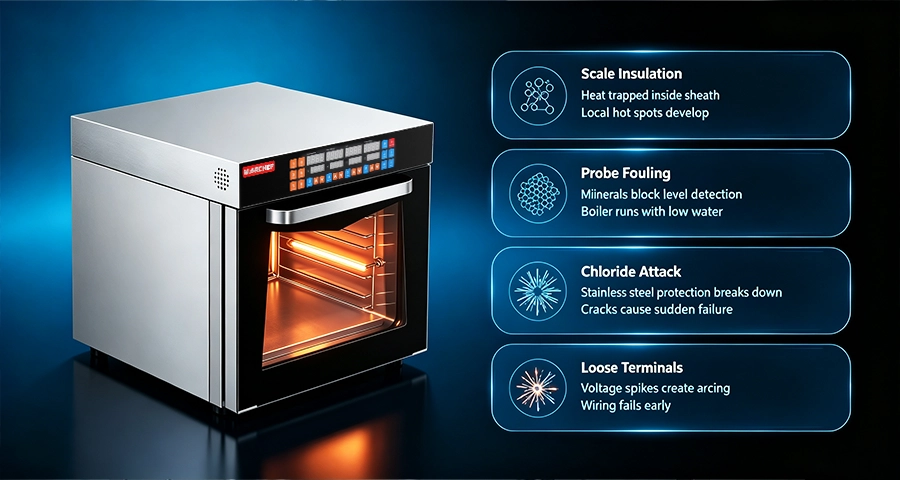
A sudden oven failure right before the dinner rush is every kitchen manager’s nightmare. I have spent years manufacturing and testing kitchen equipment, and I see this issue destroy good ovens every single month. When your heating elements fail repeatedly, the water supply is almost always the hidden culprit. Let us look closely at what is happening inside your steam generator.
How Hard Water Destroys Steam Generators and Heating Elements?
Do you notice thick white crust forming inside your boiler tank after just a few weeks of heavy use? Hard water carries heavy mineral loads that silently ruin your expensive heating components from the inside out.
Limescale accumulation creates a thermal insulation barrier on heating elements, trapping heat inside the sheath and causing localized overheating, hot spots, and element burnout. Mineral deposits on water level sensing probes also create false water-level readings, causing steam generators to dry-fire and rapidly destroy heating elements. Feedwater chloride levels exceeding 80 ppm trigger stress corrosion cracking in high-temperature stainless steel sheaths, accelerating element failure regardless of water hardness levels.
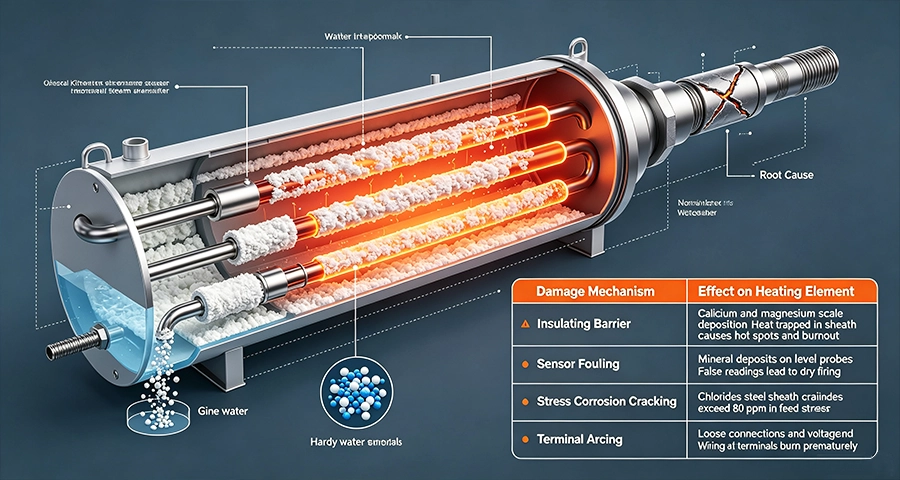
In our factory testing labs, we run continuous stress tests on heating elements. When scale builds up, heat cannot transfer into the water efficiently. The internal temperature of the element spikes past safe limits. The metal sheath cracks, water enters, and the circuit shorts out instantly.
| Damage Mechanism | Root Cause | Impact on Heating Element |
|---|---|---|
| Thermal Insulation Barrier | Calcium and magnesium scale deposits | Traps heat in sheath, causing localized hot spots and burnout |
| Sensor Fouling (Dry-Firing) | Mineral buildup on water level probes | Gives false high readings, letting elements run without water |
| Stress Corrosion Cracking | High chloride levels (>80 ppm) in feedwater | Pits stainless steel sheaths and causes sudden structural failure |
| Terminal Arcing | Loose connections and voltage instability | Burns electrical leads and terminals before sheath fails |
Sensor Fouling and Corrosion Risks
Water level probes sit directly inside the steam generator chamber. When hard water boils away, minerals coat these metal probes. The system thinks the boiler is full of water when it is completely empty. The control board turns on the power, and the heating element glows red-hot in dry air. A dry-fired element fails within minutes.
High chloride levels in your water source make this problem much worse. Heat accelerates chemical reactions. When chlorides hit hot stainless steel, they break down the protective layer of the metal. This causes tiny pits and cracks that eat through the element wall fast.
What Are Early Warning Signs of Scale Build-up in Commercial Combi Ovens?
Are your kitchen staff complaining that the combi oven takes far too long to reach cooking temperatures? Ignoring minor performance changes allows small scale layers to turn into total heating element meltdowns.
Early warning signs of scale accumulation include extended preheating times, unusual whistling or rumbling noises from the boiler during heating cycles, and erratic steam production. Addressing these early indicators prevents sudden element burnout and keeps your daily kitchen operations running smoothly without costly service calls.
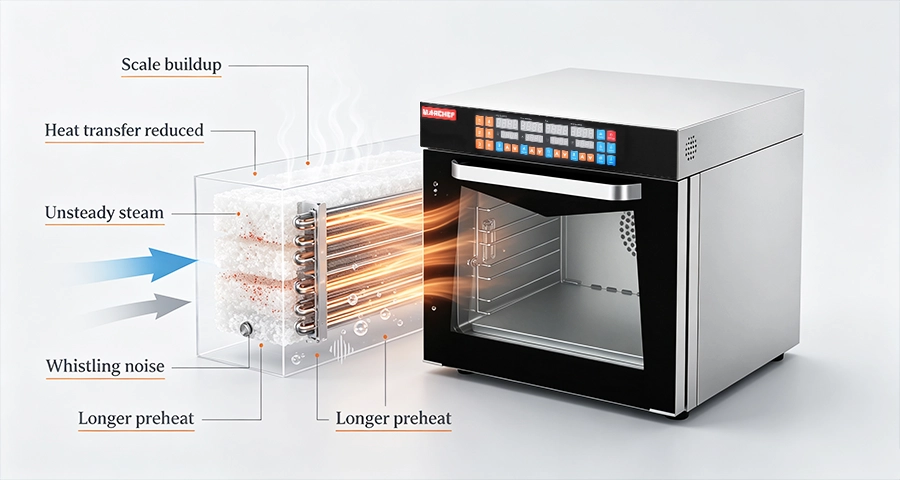
I always tell equipment operators to listen to their machines. A healthy boiler works quietly and generates strong steam quickly. When scale accumulates on the heat transfer surfaces, the physical behavior of the boiling water changes completely.
Identifying Boiler Distress Signals
- Extended Preheating Times: The oven takes ten to fifteen minutes longer to reach target steam temperatures because scale blocks heat transfer.
- Whistling or Popping Noises: Water gets trapped under thick scale layers, turns to steam instantly, and pops loudly through the crust.
- Inconsistent Steam Output: Steam comes out in uneven bursts rather than a steady flow, leaving food cooked unevenly.
- Frequent Error Codes: The control panel flashes water fill or temperature sensor errors during peak operation hours.
When scale layer thickness reaches just one millimeter, heating efficiency drops by over ten percent. Your energy bills go up while your heating elements work twice as hard to do the same job.
How to Choose the Right Water Filtration: Water Softeners vs. Reverse Osmosis?
Are you confused by all the different water treatment systems available for commercial combi ovens? Installing the wrong filtration system leaves your heating elements completely unprotected against mineral damage.
Water softeners remove calcium and magnesium ions through ion exchange, but they do not reduce total dissolved solids (TDS) or silica, making them insufficient for water with high overall mineral content. Reverse osmosis (RO) systems eliminate up to 98% of dissolved solids and chlorides, but untreated RO permeate can become acidic and aggressive, requiring remineralization or controlled blending to prevent stainless steel corrosion.
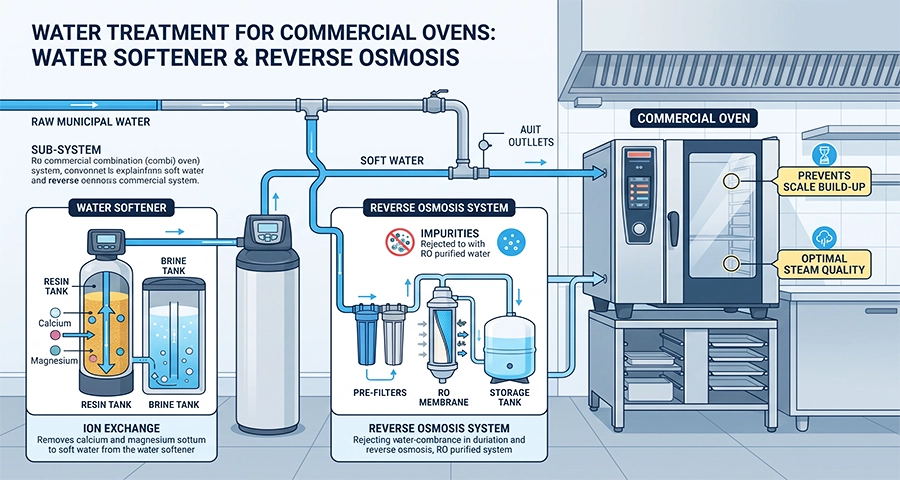
Choosing between a water softener and a reverse osmosis system depends on your local water profile. Softeners swap hard minerals for sodium ions. This stops hard scale, but it leaves all the total dissolved solids inside the water.
| Water System Feature | Standard Water Softener | Reverse Osmosis (RO) System |
|---|---|---|
| Primary Action | Removes calcium and magnesium ions | Removes 98% of all dissolved minerals |
| TDS Reduction | No reduction in Total Dissolved Solids | High reduction of TDS and chlorides |
| Chloride Protection | Low (chlorides pass through) | Excellent (removes harmful chlorides) |
| Water pH Impact | Neutral pH balance maintained | Can lower pH, making water acidic |
| Best Used For | Low TDS water with moderate hardness | High TDS and high chloride water areas |
Understanding Water Chemistry Balances
Pure reverse osmosis water presents its own unique challenges. When you strip every mineral out of water, the liquid becomes chemically aggressive. Acidic RO water seeks out minerals and actively dissolves stainless steel boiler walls and heating element sheaths.
You must use a system that blends filtered water back or adds beneficial minerals. Maintaining the right water balance protects your heating elements from both mineral scaling and chemical corrosion.
What Is a Daily & Monthly Preventative Maintenance SOP to Extend Boiler Lifespan?
Are your staff members skipping basic maintenance steps at the end of busy kitchen shifts? Without strict daily cleaning routines, scale builds up fast and destroys heating elements within months.
Daily preventative maintenance requires running auto-clean descaling programs, draining the steam generator at the end of every shift, and wiping door gaskets to maintain proper chamber sealing. Monthly maintenance SOPs must include replacing pre-filter cartridges, verifying water supply dynamic pressure (30–50 PSI), inspecting boiler drain valves for scale blockages, and testing probe sensor accuracy. Continuous high-temperature operation without adequate idle cooling cycles prevents the protective chromium oxide passivation layer on stainless steel elements from reforming, exposing the metal to accelerated chemical pitting. Loose electrical terminal connections and voltage instability at the contactor produce severe contact resistance and localized arcing, burning out element terminals before the sheath itself fails.
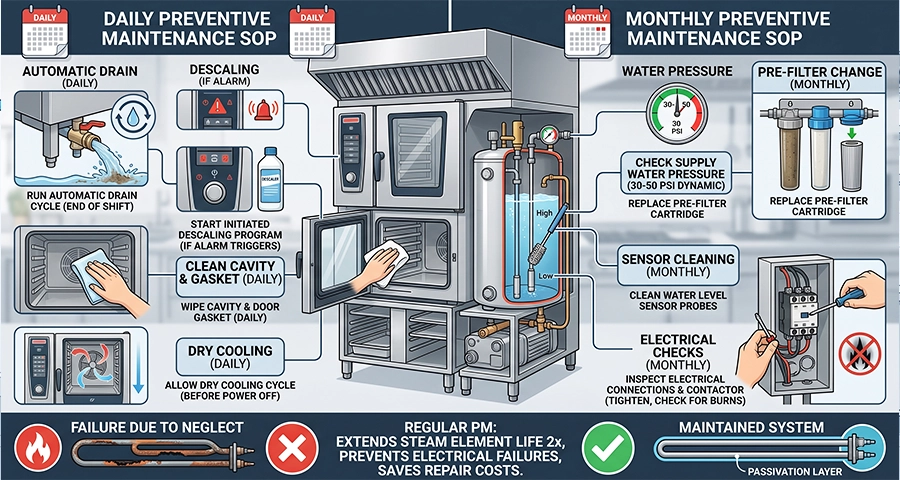
I designed this checklist based on years of field service data. Kitchens that follow these steps double the lifespan of their steam elements and avoid sudden electrical failures.
Standard Operating Procedure (SOP) Checklist
Daily Action Plan:
- Run the automatic boiler drain cycle at the end of the final shift to flush out loose sediment.
- Activate the built-in descaling cycle if the machine alerts you to scale buildup.
- Wipe down the cooking chamber and door gaskets with a soft damp cloth.
- Allow the oven to perform an idle cooling cycle before completely shutting down power.
Monthly Action Plan:
- Check water supply lines and ensure dynamic pressure stays between 30 and 50 PSI.
- Inspect water pre-filter cartridges and replace them if pressure drops occur.
- Clean water level sensor probes to remove light mineral films and prevent dry-firing.
- Inspect electrical connections at the main contactor for loose screws or burn marks.
Regular care keeps your equipment running smoothly and saves thousands in repair bills over the life of your oven.
Conclusion
Prevent combi oven element burnout by treating incoming water, cleaning level probes monthly, flushing boilers daily, and checking electrical connections regularly.