
Long queues during peak hours cost you sales and frustrate hungry guests. Standard ovens are too slow, and standard microwaves ruin food texture. You risk losing high-margin food sales every single day.
Commercial high-speed ovens combine microwave energy, convection, and high-velocity impingement air to cook food up to 15 times faster than standard ovens. Equipped with internal catalytic converters, they eliminate grease-laden vapors to meet UL 710B and EPA 202 ventless standards, removing the need for costly commercial exhaust hoods.
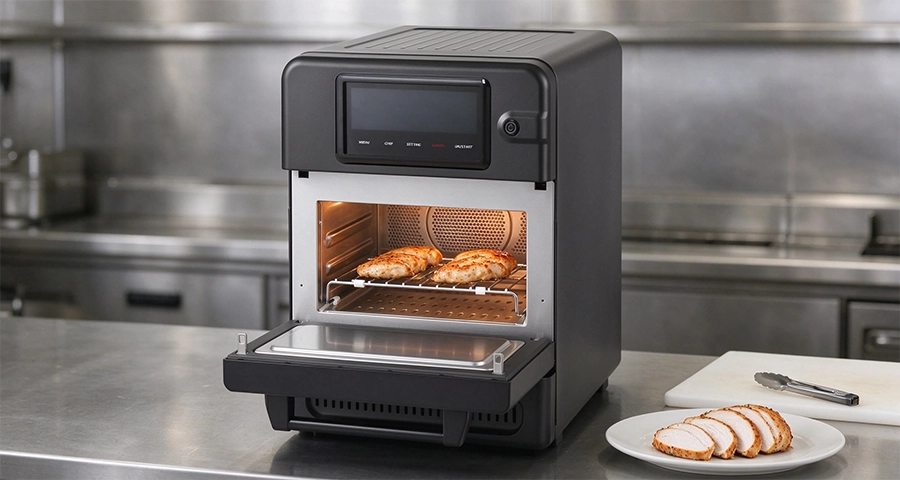
You want to serve hot, crispy meals without spending thousands on ventilation. Let us look closely at how this technology works, how it meets building codes, and how it delivers a fast return on your investment.
Why Do C-Stores and Cafes Need Two-Minute Warm Food During Peak Rush?
Morning and lunch rushes bring sudden waves of busy customers. If you cannot serve hot food within two minutes, people simply walk away. Lost minutes at the counter directly destroy your daily revenue.
High-speed ovens cook dense breakfast burritos, artisan sandwiches, and pastries in under two minutes with perfect browning. They allow cafes and convenience stores to capture high-margin grab-and-go sales, minimize customer wait times, and run efficient counter service with minimal staff training.
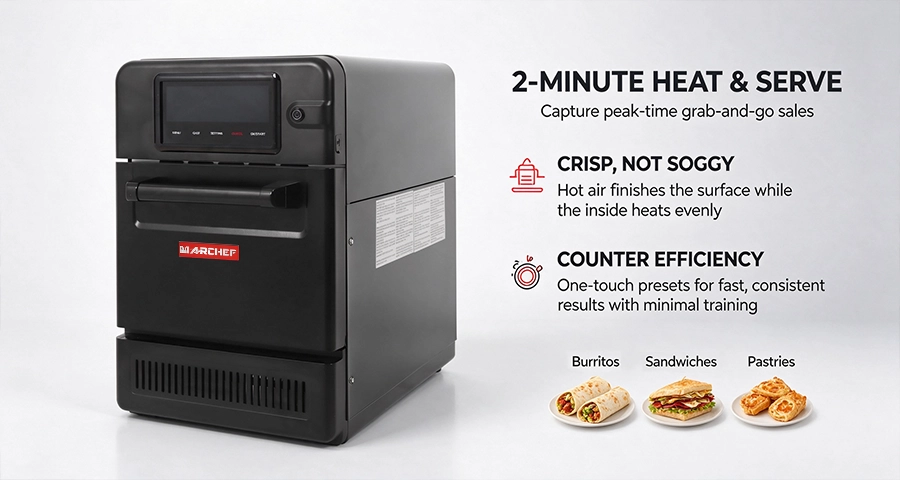
1.1 High-Margin Menu Items: Sandwiches, Burritos & Bakery
Hot food drives the highest profit margins in retail food service. Cold food simply cannot command premium prices. A toasted panini or a hot burrito yields far better margins than prepackaged snacks. Rapid cooking allows you to sell freshly heated items immediately without keeping food under heat lamps.
1.2 Speed vs. Texture: Why Standard Microwaves Fall Short
Standard microwaves heat water molecules directly inside the food. This creates internal steam that pushes outward and makes bread soggy and rubbery. Customers reject soggy sandwiches. High-speed units solve this problem by blasting the exterior with hot air while microwaves warm the core.
1.3 Counter Efficiency: Reducing Training & Peak Wait Times
High turnover in front-line staff makes complex cooking steps risky. Compact accelerated ovens use one-touch presets. An untrained worker simply inserts the food item and pushes a picture button. This keeps the queue moving fast during busy morning rushes.
| Equipment Type | Average Warm Time | Crust Texture | Staff Skill Required |
|---|---|---|---|
| Standard Microwave | 60 – 90 Seconds | Soggy and Chew | Minimal |
| Convection Oven | 8 – 12 Minutes | Crispy | Moderate |
| Commercial High-Speed Oven | 75 – 120 Seconds | Crispy and Flaky | Minimal (One-Touch) |
How Does Ventless Technology Comply with UL 710B and EPA 202 Standards?
Installing traditional ducted exhaust hoods costs tens of thousands of dollars. Many commercial locations, like airports and malls, prohibit new roof penetrations entirely. High costs and strict building codes can easily stop your expansion plans.
Ventless high-speed ovens use integrated catalytic scrubbers to destroy airborne grease and odors. They emit less than 5.0 mg/m³ of grease particulate, fully satisfying EPA Method 202 and UL 710B rules. This performance allows operators to place units in non-traditional spaces without installing ducted Type I hoods.
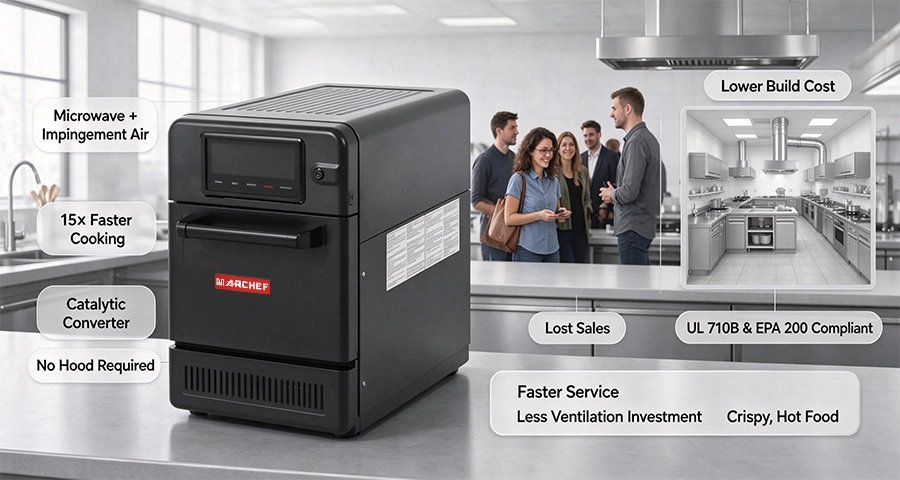
2.1 Catalytic Scrubbers: Trapping Smoke, Grease & Odors
The internal catalytic converter uses precious metal coatings to break down volatile organic compounds (VOCs). When hot, grease-laden air passes through the honeycomb structure, grease and smoke burn away into harmless water vapor and carbon dioxide. This process keeps kitchen air fresh and clean.
2.2 Emission Standards: Meeting EPA 202 (<5.0mg/m³) & NFPA 96
Under NFPA 96 codes, any cooking appliance that creates grease vapors must sit under a Type I exhaust hood. However, appliances tested under UL 710B that emit less than 5.0 mg/m³ of grease under EPA Method 202 earn an exemption. Always verify test reports before choosing a unit.
2.3 Eliminating Hoods: Saving CapEx on Mall Ductwork
A traditional commercial hood system often costs thirty thousand to eighty thousand dollars. It requires roof ducts, fire suppression systems, and make-up air blowers. Ventless units eliminate these expenses completely. You can open a compact food kiosk inside historic buildings, malls, and subway stations without structural delays.
| Compliance Parameter | Traditional Ducted Hood Setup | UL 710B Ventless High-Speed Setup |
|---|---|---|
| Total Grease Emission | Unlimited (Vented outside) | Certified < 5.0 mg/m³ (EPA Method 202) |
| Ductwork Required | Heavy-gauge welded steel | None |
| Initial Capital Cost | $30,000 – $80,000+ | $0 (Integrated in unit) |
| Installation Time | 3 – 6 Weeks | Immediate plug-and-play |
How Does Tri-Heat Physics Achieve Fast, Uniform Heating Without Cold Spots?
Fast cooking often produces poor results. Microwaves leave cold frozen spots in the center of thick proteins, while high heat burns the outer crust. Inconsistent temperatures hurt food quality and introduce serious food safety risks.
Tri-heat technology combines microwave radiation, convection airflow, and focused impingement air. Microwaves heat the moisture inside the food, convection maintains overall chamber heat, and directional air jets strip away cool boundary air to toast the surface. This balance eliminates cold cores and ensures even heating.
3.1 3-in-1 Synergy: Microwaves, Convection & Impingement
Impingement technology uses metal plates with precise nozzles to shoot high-velocity hot air straight at the food. This jet air strips away the boundary layer of cold air that naturally surrounds cold food. Meanwhile, convection heat circles the chamber, and dual magnetrons warm internal proteins quickly and gently.
3.2 Thermal Mapping: Preventing Core Cold Spots
Thick proteins like chicken fillets or frozen burritos often stay cold in standard ovens. Tri-heat systems resolve this by staging energy distribution. In early seconds, microwave energy penetrates deep into frozen proteins. Once internal moisture warms up, impingement jets finish the outside without scorching edges.
3.3 Speed vs. Conventional: Real-World Item Benchmarks
Combining these three heat transfer methods cuts cooking times by eighty percent. You can prepare fresh meals on demand instead of holding batches in heated drawers where food dries out.
| Menu Item | Standard Convection Time | High-Speed Oven Time | Time Saved |
|---|---|---|---|
| 12-Inch Sub Sandwich | 300 Seconds | 50 Seconds | 83% |
| Frozen Breakfast Burrito | 480 Seconds | 90 Seconds | 81% |
| Raw Chicken Breast | 900 Seconds | 150 Seconds | 83% |
| Fresh Flatbread Pizza | 420 Seconds | 95 Seconds | 77% |
What Keeps Magnetrons and Cavities Reliable in Heavy-Duty Environments?
Commercial kitchens place brutal demands on equipment. Continuous door slamming, trapped airborne grease, and intense all-day use cause cheap components to overheat and fail. Sudden breakdowns during peak service cost you immediate revenue and rack up expensive repair bills.
Heavy-duty commercial high-speed ovens use industrial-grade magnetrons, commercial-gauge stainless steel cavities, and robust air-cooling systems. Advanced cooling loops pull clean ambient air across critical electronics, preventing thermal throttling and protecting delicate transformers during non-stop kitchen operation.
4.1 Air-Cooled Systems: Heavy-Duty Commercial Lifespan
Industrial magnetrons produce intense heat while generating microwave frequencies. Commercial units rely on dedicated cooling fans and clear side-intake channels. If intake air paths stay clear, electronics run cool and last through years of high-volume kitchen service without unexpected shutdowns.
4.2 Cavity Durability: Commercial Stainless Steel Construction
Internal chambers face corrosive steam, salt, and grease every day. Welded commercial-grade stainless steel resists pitting, rust, and physical wear. Smooth, rounded interior corners also prevent carbon build-up and make daily sanitation fast for kitchen staff.
4.3 Low Maintenance: Filter Cleaning & Serviceability
Air filters protect internal electronics from airborne flour and grease mist. Removable front or side filters allow staff to wash screens in seconds under running water. Keeping air paths clean protects your warranty and prevents magnetron burnouts.
| Core Component | Standard Residential Grade | Commercial Heavy-Duty Grade |
|---|---|---|
| Magnetron Rating | 700W – 1000W intermittent | 1200W – 2000W continuous heavy-duty |
| Cavity Material | Coated carbon steel or thin steel | Heavy-gauge welded stainless steel |
| Air Intake Filtration | None or static mesh | Removable, washable grease filter screens |
| Thermal Management | Single small fan | Dual independent blowers with thermal monitoring |
How Do Multi-Unit Chains Standardize Menus Across Locations via USB?
Expanding across multiple locations creates difficult consistency problems. Kitchen staff in different stores might adjust cooking times manually, causing variations in quality. Uneven food quality damages brand reputation and increases food waste.
Multi-unit operators use offline USB interfaces to export standard menu profiles across dozens of store locations. Icon-driven touchscreens display clear pictures of each dish, allowing staff to run complex multi-phase cooking cycles with one touch, without needing extensive technical training.
5.1 Batch Updates: Updating 50+ Stores via Offline USB
Connecting kitchen equipment to local Wi-Fi networks often creates IT headaches and security concerns for corporate chains. Offline USB transfers keep things simple and safe. Store managers insert a USB drive into the port, load the updated recipe files in seconds, and ensure exact recipe consistency everywhere.
5.2 Visual Interface: Icon-Driven Multi-Language Displays
Modern kitchen teams often speak different primary languages. Modern interfaces use high-resolution picture icons instead of long text lists. A cook taps the picture of a croissant to start the exact baking program, which eliminates human error completely.
5.3 Staged Cooking: Multi-Phase Time & Power Presets
Dense foods require varied heat levels at different stages. Programmable ovens divide one cooking cycle into distinct steps. For example, Phase 1 applies full microwave power to defrost the center, while Phase 2 lowers microwave output and engages high-speed air jets to brown the cheese crust.
| Cooking Stage | Primary Energy Source | Target Action | Example Parameter (Toasted Bagel) |
|---|---|---|---|
| Phase 1: Defrost & Core Heat | 80% Microwave + 20% Air | Warm cold cheese and interior | 20 Seconds |
| Phase 2: Crust Browning | 20% Microwave + 100% Air | Crisp top surface and seal edges | 25 Seconds |
| Phase 3: Final Hold | 0% Microwave + 50% Convection | Set structure without burning | 10 Seconds |
What Sourcing Factors Determine Total Cost of Ownership and Long-Term ROI?
Buying low-priced equipment with poor build quality leads to expensive maintenance and early replacement. If you overlook power requirements, daily maintenance routines, and manufacturer support, hidden costs will quickly consume your initial savings.
Calculating Total Cost of Ownership involves checking energy efficiency, electrical circuit requirements, and daily cleaning routines. Sourcing units from qualified manufacturers who provide complete certification documents ensures reliable long-term performance, lower maintenance costs, and a fast financial payback.
6.1 Payback Horizon: Energy Savings & Food Waste Reductions
Because high-speed ovens run quick cycles and turn off between orders, they consume far less electricity than large convection ovens that stay hot all day. Cooking fresh items to order also cuts food waste, helping most busy retail locations earn back their equipment cost within six to twelve months.
6.2 Sourcing Checklist: Key Questions for OEM Manufacturers
When selecting a manufacturing partner, look beyond the initial purchase price. Verify factory certifications, parts availability, and technical documentation so you avoid unexpected delays during installation.
- Do the units possess verified UL 710B, CE, or local safety compliance certificates?
- What are the exact electrical demands (208V vs. 240V, dedicated 30A circuit)?
- Are replacement magnetrons, blowers, and door gaskets stocked for rapid delivery?
- Does the manufacturer provide clear maintenance protocols and non-abrasive chemical cleaners?
- Are factory-level warranties supported by direct technical assistance and parts supply?
| Evaluation Category | Critical Sourcing Checkpoint | Risk of Overlooking |
|---|---|---|
| Electrical Infrastructure | Dedicated 208-240V, 30A circuit availability | Breaker trips and installation delays |
| Daily Maintenance | Daily chemical removal of carbonized grease | Catalytic converter poisoning and element failure |
| Local Regulations | Local AHJ acceptance of UL 710B documentation | Unexpected demand for secondary exhaust hoods |
| Parts Availability | Quick access to replacement gaskets and filters | Extended kitchen downtime during peak seasons |
Conclusion
Commercial high-speed ovens deliver fast, consistent hot food without the need for expensive exhaust hoods. Choosing durable, certified units with simple controls cuts setup costs and maximizes profit margins across every location.