
Food holding carts face rough transport every day, and cheap carts break fast. Operators lose hot food, fail safety audits, and spend thousands on repairs. This practical checklist solves that problem.
Commercial mobile holding cabinets maintain safe food serving temperatures during transit between prep kitchens and banquet halls. Reliable units require digital temperature controllers, high-density foamed insulation, heavy-duty hinges, and reinforced caster channels. Selecting carts with verified ETL and CE certifications prevents unexpected food safety violations and equipment failures.
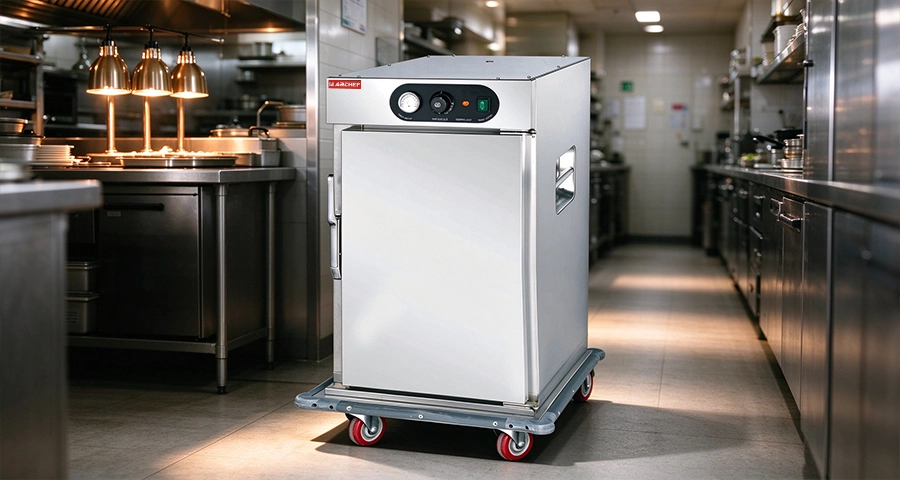
I walked through a busy banquet kitchen last month during a major gala dinner. Staff pushed forty heated carts over concrete thresholds and steep ramps. Half of those carts rattled loudly, and two doors popped open mid-hallway. That chaotic scene shows why equipment buyers must inspect build quality before signing purchase orders.
Why Do Low-Spec Carts Fail Rapidly on Thermostats and Door Hinges?
Cheap holding carts break down under daily floor vibrations. Weak dials lose calibration, food temperatures plunge into danger zones, and loose zinc hinges drop heavy cabinet doors completely.
Low-spec carts fail because transit vibration knocks basic bimetallic thermostats out of calibration and strips weak zinc hinges. Digital controllers resist vibration drift, while reinforced through-bolted stainless hinges keep doors square under dynamic transit loads, ensuring constant food safety above sixty degrees Celsius.
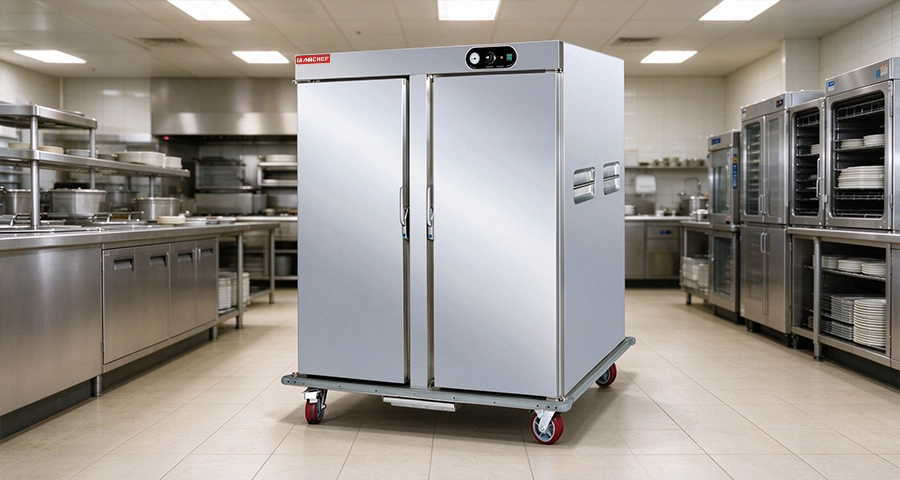
Critical Mechanical Vulnerabilities in Mobile Units
I learned this lesson the hard way five years ago. A customer called me because their banquet chicken dropped below safe temperatures during service. The analog dial looked fine from the outside, but road bumps had shifted the internal bimetallic spring. The real core temperature had fallen to fifty degrees Celsius. That mistake ruined dinner for three hundred guests.
Cheap carts use thin zinc hinges that screw directly into exterior sheet metal. Kitchen staff push full carts over threshold ramps, and the dynamic shock shears the tiny screw threads. The door sags, the gasket seal breaks, and hot air dumps into the hallway. You need heavy-duty hardware that handles rough handling without warping.
| Component Area | Economy Build Risk | Professional Sourcing Standard | Operational Impact |
|---|---|---|---|
| Temperature Regulation | Bimetallic dial drifts under vibration | Solid-state digital controller with lock | Prevents silent food safety violations |
| Door Pivot System | Surface-mounted zinc alloy hinges | Through-bolted continuous stainless piano hinges | Stops door sagging and gasket gaps |
| Latches and Catches | Exposed plastic or zinc cam latches | Recessed slam-action compression latches | Eliminates broken latches and pop-outs |
| Wiring Connections | Standard slide-on push spade lugs | Ring terminals with thread-locking screws | Prevents fire hazards and open circuits |
Which Key Features Do Hotels and Convention Centers Demand Most?
Banquet staff must transport hundreds of hot meals simultaneously across massive event facilities. Poor internal layouts cause cold spots, tilt food pans, and spill sauces all over the floor.
High-capacity convention centers demand dual-cavity carts with independent climate zones and anti-tilt universal slides. These features allow operators to hold delicate proteins and crisp sides in one footprint while transporting both standard gastronorm pans and pre-plated banquet dishes securely.
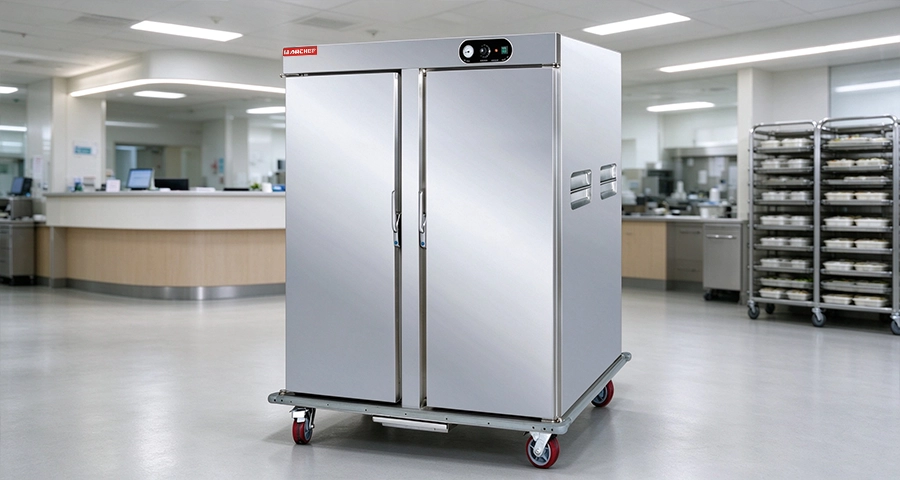
Engineering Cabinets for Fast-Paced Banquet Logistics
I spent an evening shadowing banquet servers at a thousand-seat convention center. The kitchen team packed delicate roasted beef in the top compartment and moist baked potatoes below. The dual-zone cabinet let them set different moisture and heat parameters in each section. Without separated compartments, one dish always suffers and turns soggy.
Pan stability also protects your kitchen bottom line. Regular wire racks let pans slide out when operators make sharp turns around banquet tables. Universal anti-tilt slides catch the pan lip securely. A built-in interior drip trough is another vital detail. Steam condenses on the door and runs down the frame. Without a welded catch trough, water drips onto floor tiles and ruins wheel ball bearings.
| Functional Feature | Standard Cart Limitation | High-Demand Commercial Spec | Practical Benefit |
|---|---|---|---|
| Cavity Architecture | Single open compartment | Dual insulated cavities with twin controls | Holds dry and moist dishes at once |
| Pan Support Rails | Fixed single-size wire racks | Universal anti-tilt stepped stainless slides | Accommodates GN pans and covered plates |
| Moisture Control | Passive top vent holes | Active reservoir with air duct diffusion | Prevents food from drying out |
| Water Management | Open floor drainage | Fully welded internal condensate trough | Stops wet floors and caster rust |
How Should You Audit Factory Insulation, Sealing, and Loading Volume?
Carts often look solid outside but hide loose insulation and uneven internal airflow. Poorly built bodies lose heat within thirty minutes, spoiling expensive catering batches off-grid.
Audit factory quality by checking high-density polyurethane foam-in-place insulation, vertical air distribution ducts, and multi-point magnetic gasket seals. High-grade foam maintains safe holding temperatures without power for up to four hours while strengthening the outer cabinet walls.
Structural Insulation and Chassis Reinforcement Tests
I always run a simple paper test when inspecting production runs at the factory. I shut a standard paper slip into four points along the magnetic door gasket. If the paper pulls out without resistance, heat will escape through that gap. Proper magnetic gaskets grip the frame firmly across all edges to trap internal heat.
Thermal insulation requires close scrutiny. Budget carts pack loose fiberglass wool inside the double walls. Over six months of rolling over floor bumps, that fiberglass settles down to the bottom half of the cart. The upper walls become empty metal boxes that radiate heat into the room. High-density foamed polyurethane stays in position forever. It bonds the inner and outer metal skins into a rigid box. That rigidity protects the entire body when wheels slam into walls.
| Quality Inspection Point | Typical Defect | Factory Verification Method | Performance Benchmark |
|---|---|---|---|
| Wall Insulation | Loose fiberglass settles down | Density check on injected polyurethane | Four-hour off-grid heat retention |
| Air Distribution | Top shelf ten degrees hotter | Multi-probe thermal logging under load | Less than 3°C variance across shelves |
| Perimeter Sealing | Uneven gasket contact | Multi-point paper pull-resistance check | Continuous magnetic seal on all edges |
| Chassis Base | Thin sheet metal caster tabs | Welded 10-gauge structural channel plate | Zero frame twist over floor thresholds |
Which Compliance and Safety Standards Protect Commercial Operations?
Faulty commercial warming cabinets create real electrical shocks, fire hazards, and sanitation problems. Commercial kitchens face immediate closure when health inspectors catch non-compliant holding equipment on site.
Commercial cabinets must hold genuine ETL and CE certifications to satisfy electrical safety and sanitation rules. These standards require grounded chassis paths, high-temperature heat-resistant wiring harnesses, smooth food-grade stainless surfaces, and verified cGMP cleanability across every internal corner.
Navigating Sanitation and Electrical Safety Benchmarks
I inspect electrical terminal blocks before clearing any batch of heating carts. Transport vibration puts constant pressure on power wires. If an assembler uses standard push-on spade connectors, transit shaking will work them loose. A loose spade terminal creates high electrical resistance, melts plastic sleeves, and burns out the heating element. Certified designs require screwed ring terminals and industrial ceramic blocks.
Sanitation compliance matters just as much as electrical integrity. Food particles collect in rough seams, open rivet holes, and raw metal folds. Certified sanitary cabinets use continuous welds with rounded internal corners. Kitchen staff can wipe down every interior surface with sanitizing spray in two minutes. That simple maintenance routine eliminates bacteria risks and passes local health inspections every single time.
| Standard Category | Primary Risk Factor | Required Compliance Feature | Inspection Focus |
|---|---|---|---|
| Electrical Safety | Loose wiring creates short circuits | Heavy internal heat wiring with ring lugs | CE, UL 197 electrical ground test |
| Food Sanitation | Bacterial growth in tight crevices | Coved internal corners and removable slides | NSF 4 cleanability verification |
| Material Integrity | Rust from harsh kitchen detergents | 304 food-contact stainless steel body | Salt spray resistance and alloy test |
| Thermal Safety | Exterior panels burn kitchen staff | Insulated cool-touch double-wall skin | Surface temperatures below safe limits |
Conclusion
Careful inspection of thermostats, door hinges, foamed insulation, and safety certifications guarantees reliable food holding cabinets that protect food quality and run smoothly for years.