
Commercial kitchens lose money when baking pans do not fit new ovens. Kitchen space is tight, and mismatched pans delay dinner service. You can solve this problem quickly.
To solve commercial oven pan mismatch and space shortages, you can install universal dual-fit cavity racks that support both GN 1/1 and US sheet pans, while using certified OEM vertical stacking kits to double cookline output within the exact same floor footprint.
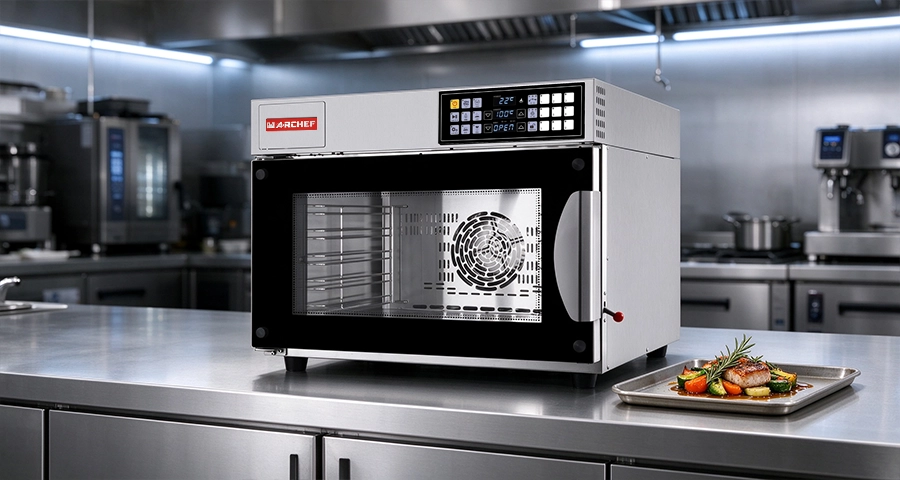
Kitchen managers often buy expensive equipment without checking pan measurements first. I made this exact mistake early in my manufacturing career, and it cost me weeks of production time. You should understand pan sizing and vertical limits before you order equipment.
Why Do GN 1/1 Pans and US Sheet Pans Fail to Fit the Same Oven?
Kitchens purchase international ovens and quickly discover that standard baking trays fall off the shelf runners. Staff waste precious prep time transferring food between different pans. This slows down busy kitchens.
A standard GN 1/1 pan measures 530 by 325 millimeters, while a US half-size sheet pan measures 457 by 330 millimeters. This dimensional mismatch prevents standard cross-market tray interchangeability.
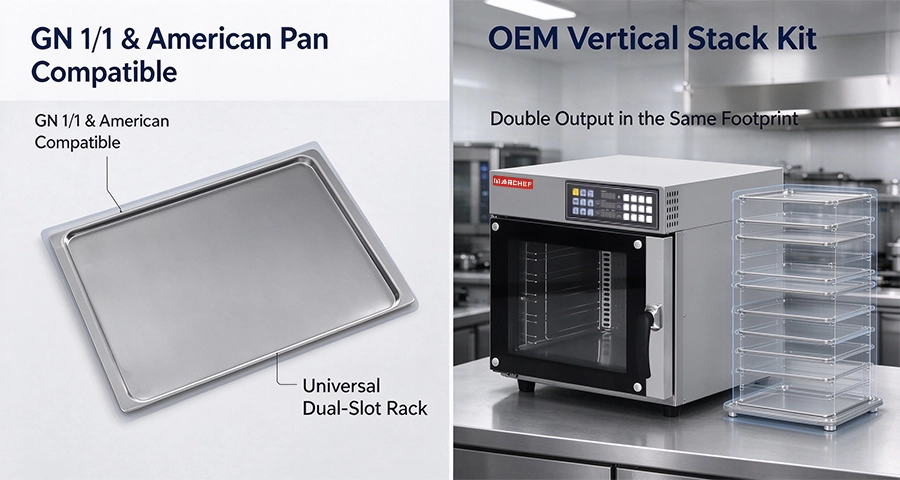
Breaking Down Pan Sizing Systems
I learned the hard truth about sheet pans during an equipment retrofit project. We shipped standard European Gastronorm combi ovens to a customer who used American sheet pans. None of their existing baking trays fit inside the oven slides.
The two standards use completely different reference points. The European Gastronorm system relies on metric modular sizing. The base GN 1/1 pan measures 530 millimeters in length and 325 millimeters in width. In contrast, the North American system uses imperial measurements based on traditional commercial baking sheets. A full-size American sheet pan measures 18 by 26 inches, which translates to 457 by 660 millimeters. A half-size sheet pan measures 18 by 13 inches, or 457 by 330 millimeters.
Because the width of a US half-size sheet pan is 330 millimeters, it is slightly wider than the 325-millimeter opening of a standard GN runner. The pan simply jams against the side wall. If you turn the pan sideways, the 457-millimeter length is too short to reach the 530-millimeter side support brackets. The pan drops straight down to the oven floor.
| Pan Standard | Length (mm) | Width (mm) | Length (in) | Width (in) | Typical Regional Use |
|---|---|---|---|---|---|
| GN 1/1 Standard | 530 mm | 325 mm | 20.87 in | 12.80 in | Global & European Gastronorm |
| GN 1/2 Standard | 265 mm | 325 mm | 10.43 in | 12.80 in | Global & European Prep Lines |
| US Full-Size Sheet | 660 mm | 457 mm | 26.00 in | 18.00 in | North American Baking Lines |
| US Half-Size Sheet | 457 mm | 330 mm | 18.00 in | 13.00 in | North American Commercial Kitchens |
How Does Universal Dual-Fit Rack Engineering Eliminate Tray Changeouts?
Cooks get angry when they must swap out hot wire racks during peak meal service. Kitchen operations stop, pans tip over, and staff risk severe burns. This ruins kitchen efficiency.
Universal dual-fit rack systems utilize stepped wire runners and dual-slot notches within a single cavity to hold both GN 1/1 depth and US half-size sheet pan widths without changing parts.
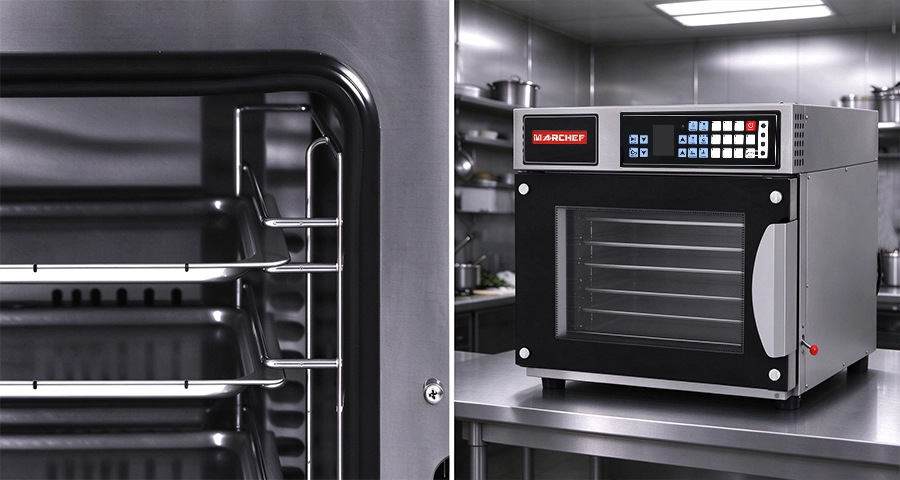
The Mechanics Behind Dual-Fit Geometry
I spent over eight months working with our sheet metal engineering team to rebuild our internal rack design. We tested various wire forming geometries to fix pan slippage issues permanently.
Standard oven cavities typically force you to choose one pan standard. If you want to switch styles, your team must remove hot internal side ladders and insert new brackets. This manual task creates burn hazards during hot shifts. Modern universal rack engineering eliminates this step through stepped wire profiles.
Engineers design the side rack runners with a dual-level channel. The lower channel section holds the 325-millimeter rim of a standard GN 1/1 pan along its long edge. The upper or outer step provides a wider 330-millimeter resting shelf for a US half-size sheet pan inserted along its short edge. The runner depth allows the 457-millimeter body of the US pan to sit securely while still supporting the deeper 530-millimeter GN pan.
This hybrid geometry gives commercial kitchens complete operational flexibility. Chefs can run Gastronorm steam pans in the morning for protein prep, and then bake cookies on American sheet pans in the afternoon without touching a single screw or side runner.
| Engineering Design | Mechanism Type | Supported Trays | Primary Benefit |
|---|---|---|---|
| Stepped Wire Runner | Dual-tier formed stainless steel wire | GN 1/1 and US 13″x18″ | No manual bracket adjustments required |
| Notched Channel Slide | Laser-cut side profile with dual stops | GN 1/1 and US 13″x18″ | Prevents pan slippage and tray binding |
| Reversible Ladder Rack | Symmetrical 180-degree flip bracket | GN 1/1 or US 18″x26″ | Easy adaptation for specialized baking lines |
Can Stacking Two Ovens Vertically Increase Kitchen Profitability?
Commercial rent prices keep climbing every year while kitchen floor space stays small. Kitchens cannot expand their walls to fit more cooking appliances. Operators lose sales when food prep bottlenecks.
Stacking two compact ovens vertically doubles production throughput per linear foot of the cookline, while occupying the exact same floor footprint as a single standalone unit.
Economic and Operational Payback of Vertical Stacking
I often review floor plans with commercial project managers who want to double their daily kitchen output. They usually assume they need to expand the kitchen hood and tear down walls to add equipment.
Vertical stacking changes this equation completely. A standard six-pan combi oven takes up about one square meter of prime cookline space. When you place a second unit directly on top using an approved stacking kit, you double your pan capacity to twelve pans without taking up an extra inch of floor space.
This configuration also cuts daily operating costs. In a single large twelve-pan oven, you must heat the entire large cavity all day, even during slow afternoon hours. With a stacked two-cavity system, you can turn off the bottom oven completely during slow periods. You run only the top unit, which cuts your idle energy consumption in half. Furthermore, stacked cavities operate with independent climate controls. Your team can steam fish in the top cavity at 100 degrees Celsius while roasting potatoes in the bottom cavity at 200 degrees Celsius at the exact same moment.
| Operational Factor | Single Large Cavity (10-12 Pan) | Stacked Dual Cavity (2 × 5-6 Pan) | Impact on Kitchen ROI |
|---|---|---|---|
| Floor Footprint | 1.0 Linear Meter | 1.0 Linear Meter | Identical space consumption |
| Cooking Flexibility | 1 Climate Mode at a time | 2 Independent Climate Modes | Doubles menu versatility during peak rush |
| Off-Peak Energy Use | High (heats entire volume) | Low (power down bottom oven) | Saves substantial monthly utility costs |
| Line Downtime Risk | Total shutdown if serviced | Partial (one unit remains working) | Protects daily operational revenue |
What Must You Check on an OEM Stacking Sourcing Checklist?
Improperly stacked ovens can tip over, leak toxic exhaust gases, or burn kitchen workers. Cheap third-party brackets can cause catastrophic structural failures during a busy shift. Kitchen safety is on the line.
An OEM stacking sourcing checklist requires verified dynamic load safety ratings, thermal heat shielding, certified exhaust flue extensions, independent drain air gaps, and strict ergonomic loading height compliance.
Critical Engineering and Safety Standards for Stacking
During a safety inspection early in my career, I saw a generic stacking stand bow under the weight of two combi ovens. The kitchen team was opening and closing the heavy glass doors quickly during service. That opened my eyes to the importance of real structural testing.
An OEM stacking kit does not consist of simple metal brackets. The base frame must pass dynamic load calculations with a safety factor exceeding 2.5 times the static weight of the units. When two ovens are loaded with heavy pans of liquid and staff jerk the doors open, dynamic torque forces can bend thin metal legs.
Thermal deflection is another critical issue. The bottom oven releases rising heat from its top surface. A proper OEM kit includes a heavy-duty thermal heat deflector and flue spacer to keep the bottom oven from overheating the sensitive electronics of the upper unit.
You must also check human safety and drain rules. International workplace standards state that the top shelf of the upper cavity must never sit higher than 63 inches (160 centimeters) from the floor. This rule keeps staff from spilling boiling liquids on their faces. Lastly, your drain manifold must use high-temperature piping with independent air gaps to stop contaminated drain water from backing up into your food.
| Critical Check Item | Engineering Specification Requirement | Hazard Prevented |
|---|---|---|
| Structural Base Rating | Safety factor > 2.5× static load weight | Equipment collapse and frame bending |
| Thermal Heat Deflector | Minimum 50 mm clearance with heat shield | Overheating of top control boards |
| Top Rack Max Height | Maximum 63 inches (160 cm) from floor | Severe hot liquid burn accidents |
| Drainage Manifold | Dual independent air gaps; 100°C rated pipe | Sewage backflow and steam vapor locks |
| Safety Certification | Factory-evaluated UL/ETL field listing | Voided warranties and building code fines |
Conclusion
Universal racks fit both pan standards, while certified stacking kits double kitchen capacity safely.