
Loud refrigerators ruin your restaurant mood. Your customers complain about the noise. I will show you how inverter compressors solve this noise problem and save your business money.
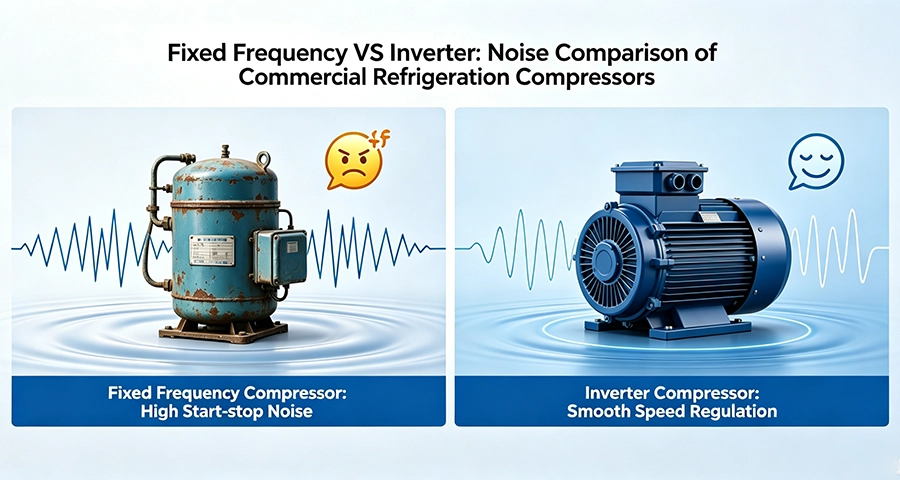
The engineering behind quieter commercial refrigeration relies on inverter compressors. Unlike fixed-frequency models that loudly start and stop at full power, inverter units smoothly adjust their motor speed. This smooth speed change stops loud noises, saves energy, and keeps a quiet environment for your kitchen and customers.
You might stop reading here if you only care about cheap prices. But you need to read more if you want happy clients. Let me explain the real differences so you make the best choice.
How Do Fixed-Frequency and Inverter Compressors Really Work?
You buy a refrigerator but do not know the parts. Bad parts break fast and cost you money. Let us look at the core engineering inside them.
Fixed-frequency compressors run on a basic start-stop cycle at full speed. Inverter compressors change their motor speed all the time to match the real cooling needs. This is the main difference in how they work inside your commercial refrigeration equipment.
Core Differences Explained
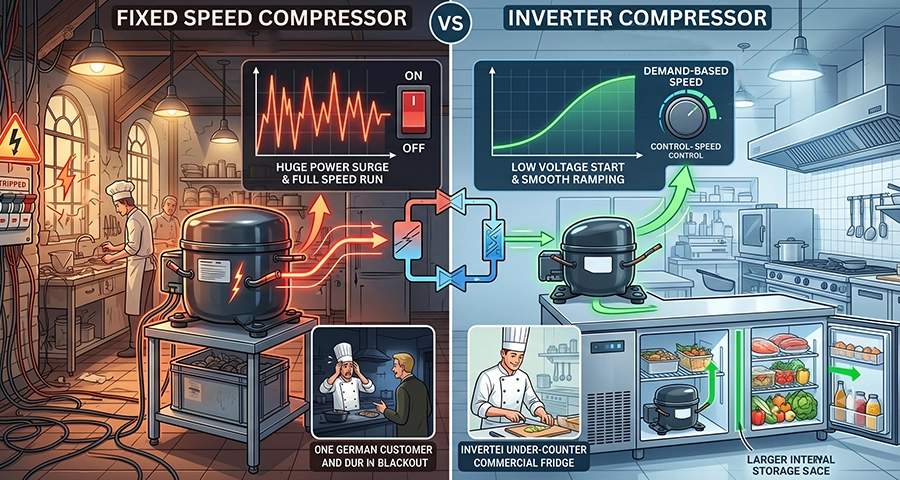
I remember a German client. He visited our factory in Guangzhou. His name was Claus. He asked me about power issues in his older buildings in Europe. I told him about power surges. Fixed-frequency compressors need a lot of power to start. They turn on at full capacity immediately. This action causes huge power surges. These large surges trip your electrical breakers easily.
Inverter compressors are very different. They start at a low voltage. They slowly go up in speed. This means they do not stress the power grid in older commercial buildings. You do not lose power during a busy dinner service.
Also, inverter compressors have a wide operating speed range. Because of this wide range, manufacturers make the physical units much smaller. A smaller compressor gives you more storage space inside the refrigerator. We use these small compressors in our under-counter commercial refrigerators. You get more space inside for your food. The outside size stays exactly the same.
Comparison Table
| Feature | Fixed-Frequency | Inverter Compressor |
|---|---|---|
| Speed Control | Always full speed | Changes speed smoothly |
| Start Power | Very high power | Low voltage start |
| Unit Size | Very large | Very small |
| Power Surges | Yes, trips breakers | No power surges |
You need to know these details when you buy equipment. It helps you avoid delays and bad reviews from your buyers.
Why Is Compressor Noise Control a Game-Changer for Modern Restaurant Chains?
Loud kitchens make customers angry. Angry customers do not come back. Noise control gives your restaurant chain a big advantage and keeps the dining area very peaceful.
Noise control is a game-changer because it improves the customer experience. Open-concept restaurants put the kitchen next to the dining area. Inverter compressors remove the loud start-stop noises. They use smooth speed ramping instead. This keeps the whole restaurant quiet and comfortable.
The Impact of Noise on Your Business
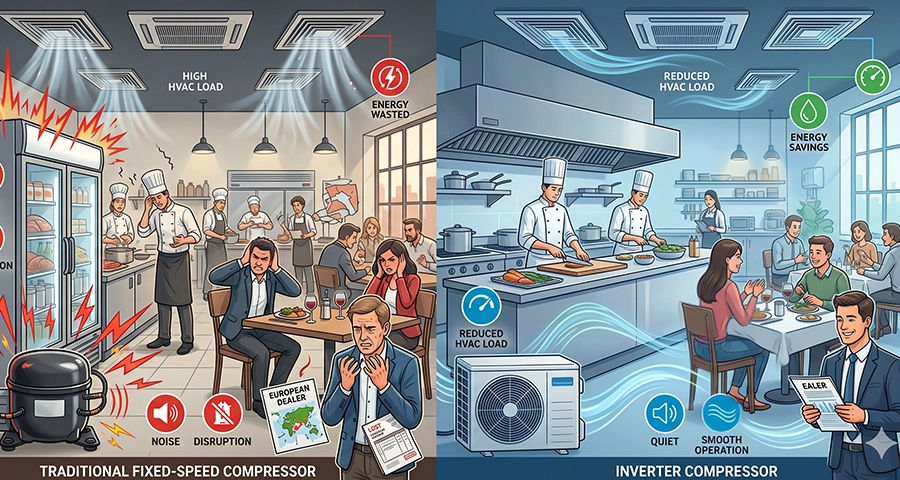
Many modern restaurant chains use open-concept layouts. The kitchen is right inside the dining room. Customers hear loud refrigerators. I talked to a distributor in Europe last year. He lost a big deal. His refrigerators were too noisy. Fixed-speed units have abrupt start-stop cycles. They are very loud. Inverter compressors fix this noise problem completely. They use smooth speed ramping. The acoustic footprint is much lower. Your customers eat their food in peace. You sell more food when the restaurant is quiet.
Heat and HVAC Costs
Another big point is heat. Inverter compressors lower noise. They also reduce the heat in the kitchen. They run very slowly during low-load times. They make less heat. This heat reduction helps your restaurant a lot. It decreases the load on your restaurant HVAC system. Your air conditioning works less. You pay lower cooling costs for the whole building.
Noise and Heat Benefits
| Compressor Type | Noise Level | Heat Output | HVAC Cost |
|---|---|---|---|
| Fixed-Frequency | Very loud | High heat | High cost |
| Inverter | Very quiet | Low heat | Low cost |
I always tell buyers to think about the whole building. You save money on air conditioning when you choose the right refrigerator.
Does Performance Go Beyond Silence with Precision Temperature Control and Food Safety?
Spoiled food ruins your restaurant reputation. Bad temperature control wastes your inventory. Precision temperature control keeps your food safe and makes your business very successful.
Yes, performance goes far beyond silence. Inverter compressors constantly adjust their cooling power. This prevents sudden temperature changes inside the refrigerator. A stable temperature ensures strict compliance with food safety rules. It also preserves your fresh food inventory for a longer time.

Why Temperature Stability Matters
Food safety is the most important thing in a commercial kitchen. Bacteria grow fast when the temperature goes up and down. Fixed-frequency compressors turn completely off. They do this when they reach the target temperature. Then the inside gets warm. After it gets warm, the compressor turns on again at full speed. This makes sudden internal temperature fluctuations. I had a client with a bad supplier. He bought cheap fixed units. His food spoiled quickly. He lost a lot of money. Angry customers left bad reviews.
Inverter compressors fix this problem easily. They constantly adjust their cooling capacity. They never really turn off. They just slow down. This stops sudden temperature changes. Your perishable inventory stays very safe. You always meet strict food safety regulations. Your fresh meat and vegetables last a longer time.
Food Safety Comparison
| Feature | Fixed-Frequency | Inverter Compressor |
|---|---|---|
| Cooling Process | Stops and starts | Constant adjustment |
| Temperature | Goes up and down | Very stable |
| Food Safety Risk | High risk | Low risk |
| Inventory Life | Short life | Long life |
When you buy top quality products from our factory, you protect your food and your customers. You will never worry about spoiled food again.
Which Compressor Fits Your Clients’ Commercial Kitchen Layout Better?
Choosing the wrong equipment wastes your money. A bad fit ruins your kitchen workflow. A smart buying guide helps you pick the exact right compressor for your clients.
Your choice depends on the kitchen setup and budget. Fixed-frequency units have a lower purchase price and work well for constant demands. Inverter compressors cost more at first but save up to fifty percent in energy. They also have lower long-term operational costs.
Making the Right Choice
Every commercial kitchen is different. You are a B2B buyer. You need to match the product to the exact need. My client is very sensitive to price and quality. He asked me about choices. I told him the absolute truth. Fixed-frequency units are not bad products. They have a lower initial purchase price. They are highly effective for constant cooling demand. Large walk-in cold storage rooms use them. The doors do not open often. The temperature stays the same all day.
Busy kitchens need inverter compressors. They reduce energy consumption by thirty to fifty percent. They decrease mechanical wear. They lower your long-term operational costs. They do not break down often. Today, many modern large-scale commercial systems use a hybrid configuration. They pair fixed-speed compressors for stable base loads. Then they use inverter compressors for fluctuating peak service demands.
Buying Guide Table
| Layout Need | Best Compressor Choice | Reason to Choose |
|---|---|---|
| Walk-in cold room | Fixed-Frequency | Low initial price, constant demand |
| Busy open kitchen | Inverter | Low noise, high energy savings |
| Large scale system | Hybrid setup | Handles both base and peak demands |
We control our quality closely so you never face delivery delays. We want you to succeed in your business.
Conclusion
Inverter compressors lower noise, save energy, and keep food safe. Fixed models work best for steady cold rooms. Choose the right engineering to help your clients and grow your business.