
Buying the wrong commercial fryer batch kills your profit margins fast. One mismatch in voltage or relay durability causes costly returns and angry restaurant buyers during peak season.
Before sourcing programmable electric fryers, equipment dealers must verify local voltage and phase compatibility, heavy-duty contactor ratings, IPX4 panel protection, dual-certified CE or cETLus listings, and tank capacity against kitchen volume. Checking these core specs prevents field failures, eliminates false warranty claims, and protects dealer margins.
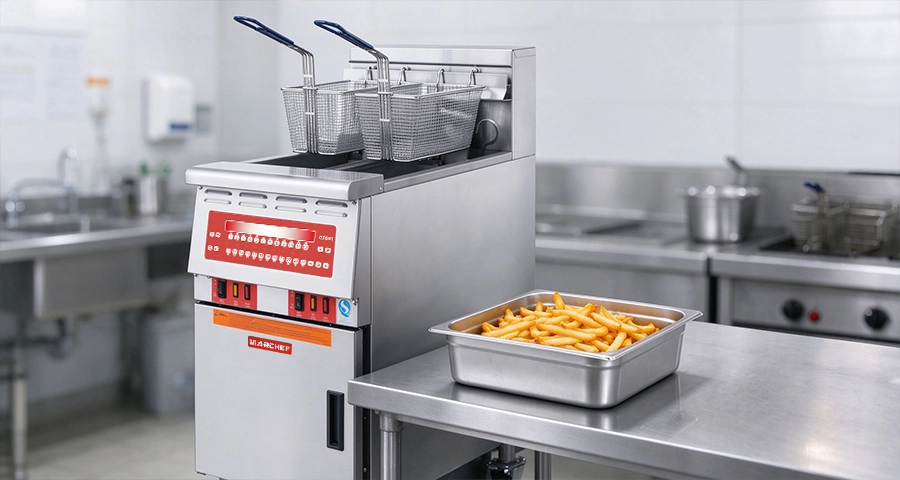
I learned this lesson the hard way years ago at my factory in Guangzhou. A buyer ordered fifty units without checking the local power grid setup. When the units arrived, the kitchen staff could not plug them in. We had to ship new wiring harnesses across the ocean. You do not want that headache in your warehouse. Let us look at the exact hardware details you need to check before placing your next bulk order.
How Should Dealers Prepare Stock for Black Friday and Peak QSR Volume?
Q4 rushes destroy weak kitchen equipment. If your warehouse runs out of high-recovery fryers in November, your quick-service restaurant clients will buy from your competitors instead.
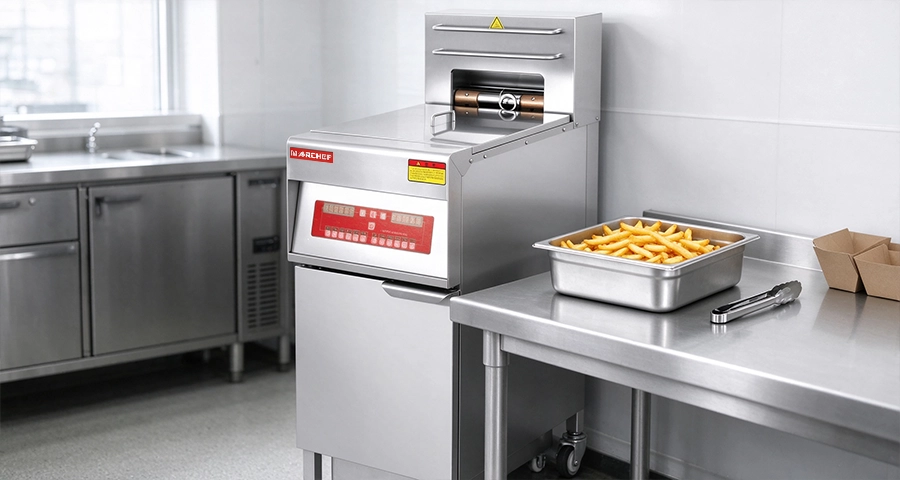
To prepare for Black Friday and Q4 QSR volume, dealers must stock high-wattage 12 kW to 18 kW floor-standing fryers alongside dual-frequency 50/60Hz filtration motors. Building inventory early prevents shipping bottlenecks and ensures kitchens have rapid oil recovery times during peak holiday rushes.
Matching Power Output to Q4 Demand
During holiday sales, quick-service restaurants drop frozen fries and chicken wings nonstop. Standard fryers lose heat fast when cold food hits the oil. I always tell dealers to check the kilowatt rating before stocking up for winter. Units rated between 12 kW and 18 kW heat the oil back up in seconds. If you sell a weak unit to a busy burger shop, their food comes out soggy.
Reducing SKU Complexity Across Markets
Managing warehouse space gets messy when you supply different regions. I recommend sourcing fryers with dual-frequency 50/60Hz filtration pump motors. This simple spec lets you use the same filtration parts for different power grids. You hold fewer spare parts on your shelves, and your warehouse team ships orders faster.
| Peak Season Metric | Low-Volume Setup | Peak Q4 QSR Requirement |
|---|---|---|
| Heating Power | 3 kW – 6 kW | 12 kW – 18 kW |
| Oil Recovery Time | Slow (3+ minutes) | Fast (Under 60 seconds) |
| Filtration Motor | Single frequency (50Hz or 60Hz) | Dual-frequency (50/60Hz) |
| Recommended Stock Timing | Just-in-time ordering | 90 days before Black Friday |
How Can Heavy-Duty Contactors and Panel Protection Lower RMA Costs?
Warranty returns eat your profits alive. A single fried control board or welded relay forces your tech team to make expensive service calls during busy dinner rushes.
Dealers lower RMA costs by sourcing fryers with heavy-duty contactors rated for continuous inductive cycling, IPX4 waterproof front control panels, and secondary analog backup thermostats. Technicians must also check manual hi-limit reset buttons before delivery to prevent false dead-on-arrival claims.
Stopping Relay Failure and Water Damage
Inside an electric fryer, electrical switches turn on and off thousands of times a week. Cheap relays melt and weld together under this constant load. When that happens, the heating elements stay on and burn the oil. I make sure our production line uses heavy-duty mechanical contactors or solid-state relays built for nonstop cycling. Also, kitchen staff spray water and degreaser everywhere at night. Your control panels need at least an IPX4 rating so grease vapor and washdowns do not short out the electronics.
Preventing False Dead-on-Arrival Claims
Last spring, a dealer called me in a panic because ten new fryers would not turn on. I asked his technician to press the manual hi-limit reset button under the control box. All ten units fired right up. Rough ocean freight and truck bumps often trip this safety switch during shipping. Train your warehouse team to check this button before shipping to the end user. Also, look for fryers with a secondary analog thermostat inside. If the main computer chip ever fails during a Friday night rush, the chef can flip a switch and keep cooking.
| Failure Point | Root Cause | Hardware Fix |
|---|---|---|
| Stuck Heating Elements | Contact welding from high cycling | Heavy-duty contactors or solid-state relays |
| Dead Control Screen | Grease and washdown water entry | IPX4 or higher panel sealing |
| False DOA Return | Freight vibration tripping safety switch | Pre-delivery manual hi-limit reset check |
| Total Down Time | Digital microprocessor failure | Secondary analog backup thermostat |
Why Do Franchise RFPs Require Computer Controls Over Manual Dials?
Large restaurant chains reject bids that only offer basic dial fryers. Without programmable controls, teenage kitchen staff overcook food, waste expensive cooking oil, and fail franchise audits.
Franchise RFPs mandate programmable computer controllers because they store 12 to 50 menu presets and adjust cooking times automatically when frozen food drops the oil temperature. Manual dials cannot compensate for temperature dips, leading to uneven food quality and higher oil waste.
Eliminating Human Error on the Line
When I visit chain restaurants, I see high staff turnover everywhere. New cooks do not know how long to fry thick chicken tenders versus thin shoestring fries. Manual dials rely on the cook setting a timer and watching the clock. Programmable computer controllers solve this problem immediately. Managers lock in 12 to 50 menu presets. The cook just presses one button and drops the basket.
Smart Temperature Compensation
The real magic of a good digital controller is sensitivity compensation. When a cook drops two baskets of frozen food into hot oil, the oil temperature plunges. A basic manual dial keeps the heat on, but the timer runs at the same speed, leaving the food raw inside. A smart computer board senses the exact temperature drop and stretches the cooking time automatically. That is why every major franchise RFP demands digital controls today.
| Control Feature | Manual Dial Fryers | Programmable Computer Controls |
|---|---|---|
| Menu Presets | None (Manual setting) | 12 to 50 locked recipes |
| Cold Load Adjustment | None (Causes undercooking) | Automatic time compensation |
| Staff Training Time | High (Requires cooking skill) | Low (One-button operation) |
| Franchise RFP Eligibility | Rejected by major chains | Mandatory standard |
How Do Countertop and Floor-Standing Fryers Compare on Margins and Footprint?
Selling a bulky floor fryer to a tiny cafe leads to cancelled orders. Selling a weak countertop unit to a high-volume restaurant guarantees angry calls about slow food.
Countertop electric fryers draw 3 to 6 kW for tight spaces and lower upfront price points, while 16L to 28L floor-standing models draw 12 to 18 kW for high-volume output. Floor models deliver higher dollar margins per sale, while countertop units offer faster inventory turnover.
Balancing Floor Space and Power Draw
Small coffee shops, food trucks, and bars rarely have three-phase power or wide exhaust hoods. For these buyers, countertop units drawing 3 to 6 kW are the best fit. They sit right on a stainless steel prep table and handle side orders easily. On the other hand, dedicated fried chicken shops and busy diners need 16L to 28L floor-standing fryers. These heavyweights pull 12 to 18 kW and hold massive amounts of oil so the heat stays steady all day.
Maximizing Your Dealer Profit Strategy
From a wholesale perspective, you need both styles in your catalog to protect your bottom line. Countertop fryers move fast because the price tag is low, giving you steady cash flow every month. Floor-standing 16L to 28L models take up more pallet space, yet they bring in much bigger gross profit dollars per invoice. Plus, floor models allow you to upsell built-in oil filtration systems and matching dump stations.
| Specification | Countertop Fryers | Floor-Standing Fryers (16L–28L) |
|---|---|---|
| Power Rating | 3 kW – 6 kW | 12 kW – 18 kW |
| Kitchen Footprint | Compact (Sits on prep table) | Dedicated floor space under hood |
| Target Buyer | Cafes, food trucks, bars | QSRs, hotels, high-volume diners |
| Dealer Profit Profile | High volume, lower ticket | Higher margin per unit + accessories |
What Electrical and Safety Certifications Must Fryers Pass Before Import?
Customs agents will seize non-compliant containers at the port. Even if the units clear customs, local electrical inspectors will shut down a restaurant if the nameplate specs are wrong.
Before importing, dealers must verify CE markings for Europe or dual cETLus and ETL-Sanitation listings for North America. You must also match nameplate voltage and phase wiring to the local grid, as units above 6 kW require hardwiring or high-amperage plugs like NEMA 15-60P.
Navigating Regional Safety Marks
Never trust a factory that only shows you a basic self-declared certificate. If you sell into North America, your fryers must carry dual cETLus and ETL-Sanitation marks. Health inspectors treat these as the direct equivalents to UL and NSF standards. If you distribute in Europe, valid CE marking backed by real lab test reports is mandatory for legal market entry. Always ask for the actual certificate numbers so you can verify them online before wiring your deposit.
Avoiding Catastrophic Wiring Mistakes
Electric fryers pull massive power, so plug and phase mistakes ruin equipment instantly. Units rated above 6 kW cannot plug into a standard wall outlet. They require dedicated hardwired circuits or heavy-duty plugs like a NEMA 15-60P. Even more important, you must check the phase configuration on the metal nameplate. If an installer wires a three-phase 220V fryer into a single-phase power supply, the surge will blow the computer control boards in seconds.
| Compliance Area | North American Standard | European / International Standard |
|---|---|---|
| Electrical Safety | cETLus (UL equivalent) | CE (Low Voltage Directive) |
| Food Hygiene | ETL-Sanitation (NSF equivalent) | CE / Food-grade stainless compliance |
| High-Power Connection (>6 kW) | Hardwired or NEMA 15-60P plug | Hardwired or industrial CEE red plug |
| Critical Wiring Check | Exact phase match (1-Phase vs 3-Phase) | Exact phase match (230V vs 400V) |
Conclusion
Verifying power phases, heavy-duty relays, waterproof controls, tank sizes, and safety listings protects your warehouse from costly returns and keeps your commercial kitchen buyers profitable.