
Running out of kitchen equipment during peak season destroys sales. High demand hits hard, but manufacturing delays and slow shipping lead to lost profits and angry retail clients.
Planning your equipment sourcing three to six months before peak summer and holiday seasons prevents mid-season stockouts. Early ordering accounts for manufacturing, freight shipping, and customs clearance lead times to secure continuous supply.
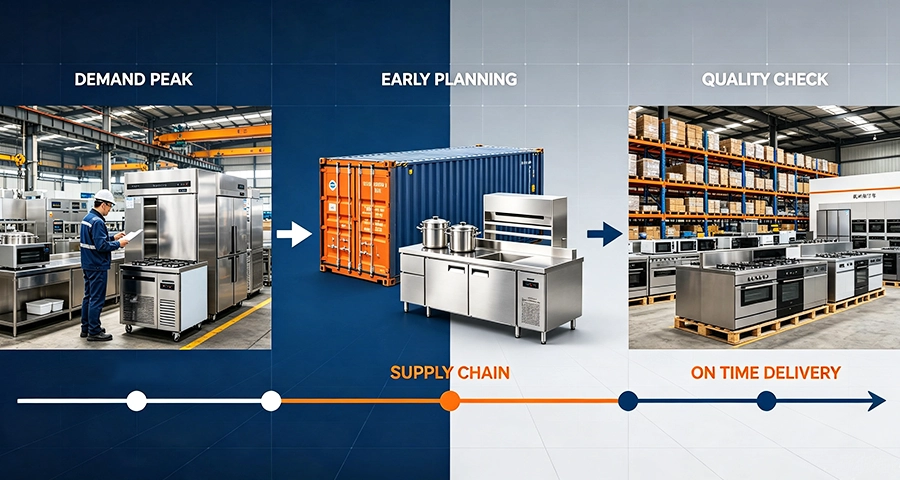
I run two factories in China producing heavy-duty commercial equipment and refrigeration. Over the years, I have seen many European distributors panic when summer hits because their stock arrives late. I learned that managing supply chains requires direct communication, early planning, and precise quality checks long before the rush starts.
Analyzing B2B Market Trends for Ice Cream and Commercial Grilling Categories?
Buying outdated machinery models wastes capital and creates dead inventory. Old ice cream and grilling units fail to meet new efficiency standards and changing consumer menu trends.
B2B demand for ice cream machines is shifting toward automated, energy-efficient continuous freezers. Commercial grilling equipment sourcing favors high-capacity electric and induction grills with digital controls over traditional gas units.
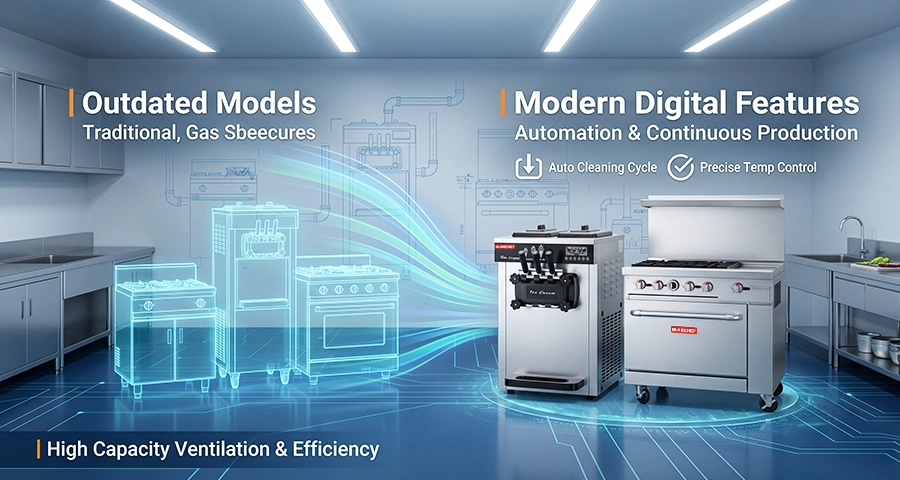
Market Trends in Ice Cream and Grilling Equipment
Market preferences for commercial kitchen machinery are changing fast across retail networks. Commercial kitchens and fast-food chains now look for equipment that reduces power consumption and saves daily labor costs.
In the ice cream sector, continuous freezers with automated cleaning cycles are replacing manual gravity-feed models. Operators need machines that process alternative dairy, plant-based, and low-sugar formulations without clogging. These specialized mixes require precise digital temperature management to maintain smooth textures.
For commercial grilling, high-capacity electric and induction grills are replacing traditional gas units. Cities enforce strict commercial kitchen ventilation regulations and energy efficiency standards. Programmable digital controls allow kitchen staff to cook food evenly with minimal training.
| Category | Traditional Models | Next-Gen Sourcing Focus | Key Market Driver |
|---|---|---|---|
| Ice Cream Machinery | Manual gravity-feed systems | Automated continuous freezers | Plant-based mixes & automated cleaning |
| Grilling Equipment | Standard gas flat-tops | Programmable electric & induction | Ventilation laws & energy efficiency |
| Refrigeration Units | Basic static cooling | Inverter compressors & eco-gas | Reduced power bills & strict compliance |
I stock raw steel and key components early in my Guangzhou factory. This production setup lets us build modern digital features for buyers without extending manufacturing lead times during peak ordering months.
Managing Lead Times and Sourcing Cycles to Prevent Mid-Season Stockouts?
Waiting until peak season starts to order machinery guarantees severe delivery delays. Overseas factory queues, ocean freight shipping, and customs inspections take far more time than buyers calculate.
Implementing Vendor-Managed Inventory programs and shared digital demand-forecasting platforms between buyers and manufacturers minimizes order-processing delays. Starting procurement three to six months ahead completely eliminates mid-season equipment stockouts.
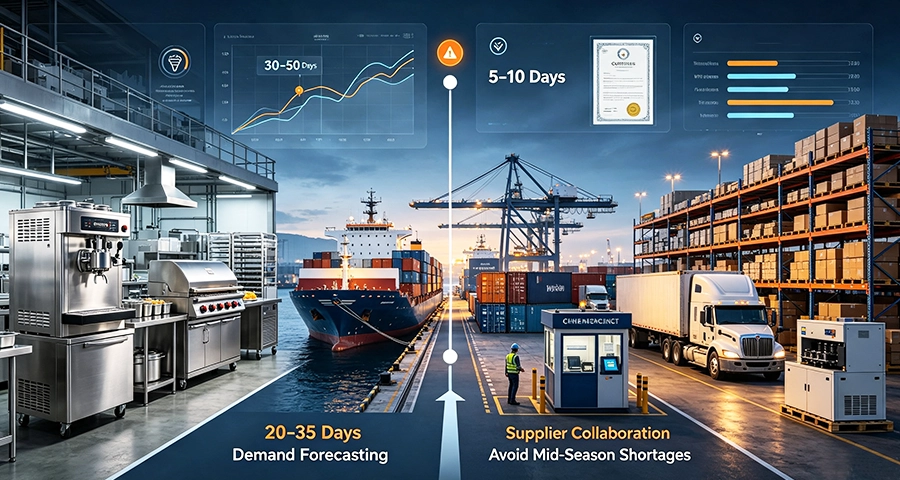
Structuring Sourcing Cycles and Lead Times
Equipment distributors lose significant revenue when they do not map out their supply chain timing. A complete overseas procurement cycle includes several distinct physical and administrative stages.
First, factory production requires three to six weeks depending on order volume and custom design specifications. Second, ocean freight shipping takes another four to eight weeks depending on destination ports. Third, local customs clearance, port handling, and inland trucking add additional days to the timeline.
| Sourcing Stage | Average Time Needed | Potential Risk Factor | Action to Prevent Delays |
|---|---|---|---|
| Production & Testing | 20 to 35 Days | Raw material shortages | Place orders during off-peak months |
| Ocean Freight Shipping | 30 to 50 Days | Port congestion & vessel delays | Book cargo containers weeks in advance |
| Customs & Last Mile | 5 to 10 Days | Paperwork errors | Verify CE and ETL certificates early |
We use shared demand forecasting with our long-term European distribution partners. When buyers share their projected retail sales volume early, we lock in component costs and reserve factory production lines for them.
Assessing Manufacturing Quality: Material Durability and Wear-and-Tear Component Life?
Low-quality kitchen machinery breaks down under continuous daily use during peak sales periods. Low-grade steel rusts, and weak components fail when kitchens operate at maximum capacity.
Assessing structural quality requires specifying food-grade 304 or 316 stainless steel, heavy-gauge frame construction, and seamless anti-microbial welded joints. Pre-season maintenance audits identify high-wear components like compressor seals, door gaskets, heating elements, and scraper blades to establish replacement cycles before peak periods.
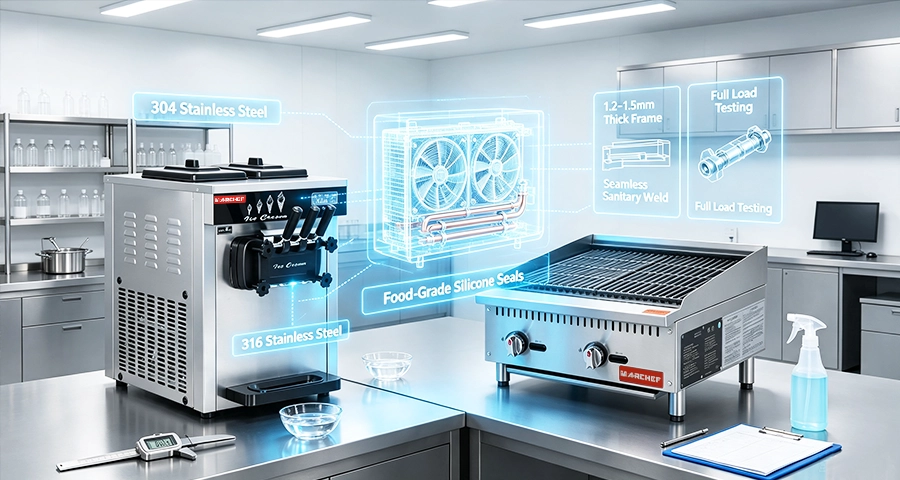
Structural Quality and Critical Wear Components
You must examine physical material specifications when sourcing commercial kitchen equipment. Stainless steel grades determine how well machines withstand harsh kitchen environments over time.
Grade 304 stainless steel resists water corrosion and food acids. Grade 316 stainless steel withstands aggressive sanitizing chemicals and heavy salt exposure. Thin metal sheets bend under heavy cookware, so buyers must require heavy-gauge frame construction. Seamless welded joints eliminate gaps where bacteria grow, making daily sanitization easier for staff.
| Component / Feature | Low-Quality Standard | Commercial Grade Standard | Operational Benefit |
|---|---|---|---|
| Steel Material | 201 Stainless Steel | 304 or 316 Stainless Steel | Prevents rust and chemical corrosion |
| Frame Thickness | Under 0.8 mm sheet metal | 1.2 mm to 1.5 mm heavy gauge | Holds up under continuous heavy use |
| Welding Type | Spot welded seams | Fully welded anti-microbial joints | Improves structural strength and sanitation |
| Wear Components | Generic rubber seals | Food-grade silicone & heavy seals | Prevents fluid leaks under high heat |
Every machine in our factory undergoes strict testing to comply with CE and ETL standards before shipping. We run compressor seals, heating tubes, and motor drives under full load to catch mechanical defects early.
Establishing Reliable After-Sales Support and Spare Parts Logistics for Retail Clients?
A broken refrigerator or fryer during peak summer weekend hours creates immediate revenue loss. Waiting weeks for replacement parts destroys trust between retail clients and equipment suppliers.
Regional spare parts warehousing and localized component stockpiling reduce emergency repair lead times to under 24 hours. Modular machinery designs allow plug-and-play component replacement without complete equipment teardowns. B2B contracts use Service-Level Agreements to guarantee maximum technician response times and lock in standardized spare parts pricing across retail networks.
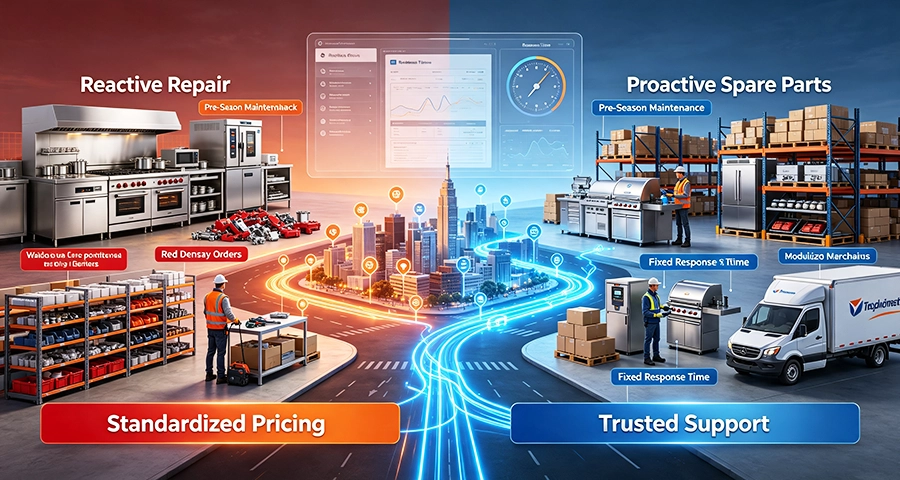
Building an After-Sales and Logistics Framework
Distributors must build a practical maintenance network to support commercial kitchens during peak demand periods. Long delays for replacement parts cause severe operational downtime for food service businesses.
First, establish regional warehousing for high-wear spare parts. Keep door gaskets, heating elements, digital controllers, and scraper blades stocked locally. Second, select machinery built with modular designs. Modular parts let field technicians swap out failing components without taking entire machines apart.
Third, enforce clear Service-Level Agreements with fixed response times. Guaranteeing spare part availability and locked pricing builds long-term reliability for retail clients.
| Support Strategy | Traditional Reaction Method | Modern Sourcing Method | Value to Retail Client |
|---|---|---|---|
| Parts Stocking | Order parts after failure | Local warehouse stockpiling | Reduces equipment downtime to hours |
| Machine Design | Complex built-in components | Modular plug-and-play modules | Simplifies component replacement |
| Maintenance | Wait for complete breakdown | Pre-season maintenance audits | Replaces worn parts before peak season |
I always advise our commercial buyers to bundle essential wear-and-tear parts inside their initial machinery shipments. This simple step gives local service technicians immediate access to vital components during urgent repair calls.
Conclusion
Sourcing commercial machinery requires early supply chain planning, strict material checks, and local spare parts logistics. Planning procurement three to six months ahead prevents stockouts and ensures continuous operation during peak months.