
Are soaring utility bills and slow recovery times slowing down your commercial kitchen during busy dinner rushes? Choosing the wrong fryer fuel costs thousands in unexpected utility upgrades, high operating bills, and constant food delays.
To choose the right commercial fryer fuel, calculate your available utility infrastructure, peak production volume, and local energy rates. Electric models offer 75% to 85% thermal efficiency with simple venting, while natural gas delivers the lowest running cost and fastest recovery for high-volume frying.
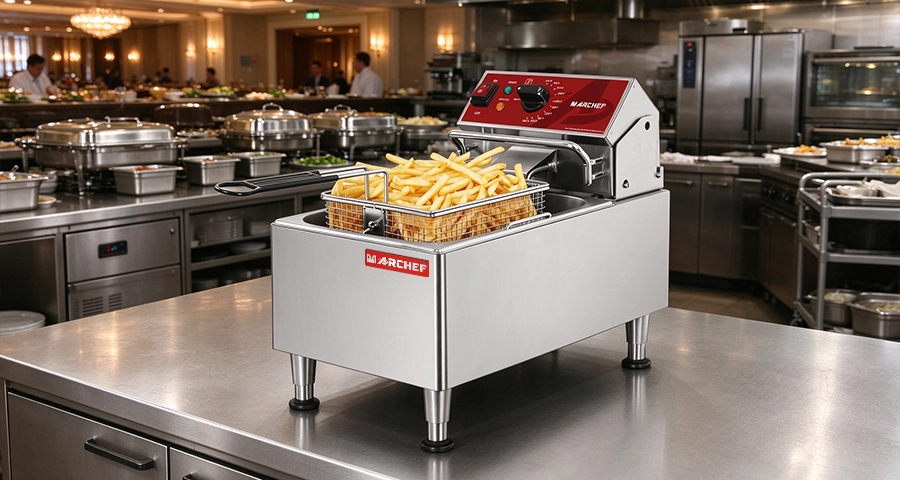
I spent years manufacturing commercial cooking gear and outfitting kitchens, and I have seen many operators buy fryers that their utility connections could not handle. Selecting the correct energy source requires a clear review of utility capacity, ventilation rules, and total lifetime expenses.
Which Fuel Delivers the Best Energy Efficiency and Operating Costs?
Are electric spikes eating up your monthly profits, or is your gas equipment venting too much heat into the room? Rising energy rates turn every cooking cycle into a budget risk if your burners do not match your utility supply.
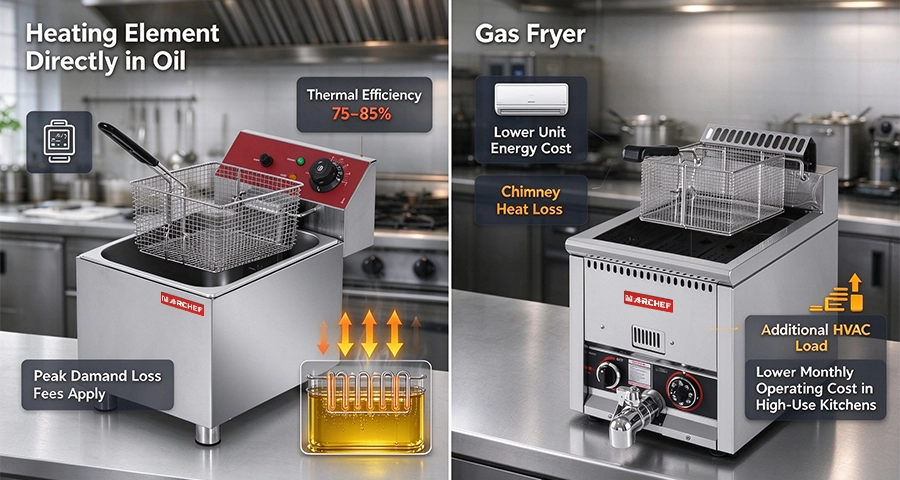
Electric fryers deliver superior thermal efficiency between 75% and 85% because their immersion elements sit directly in the cooking oil. However, piped natural gas typically yields lower monthly operating bills during high-volume production due to heavy peak electrical demand charges and cheaper gas therm costs.
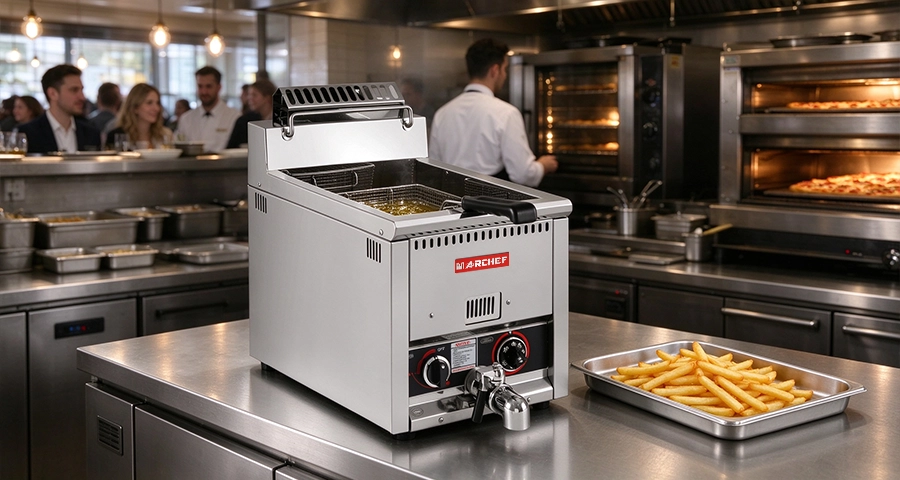
I often see buyers confuse thermal transfer efficiency with real utility expenses. Immersion heating elements sit directly in the frying vat. They transfer heat right into the cooking oil with very little heat waste. Standard gas fryers pull heat through tubes or pot walls, which wastes substantial energy out of the flue stack.
However, raw utility pricing changes the final cost balance. High-output commercial electric fryers pull large electrical loads. Electric companies charge steep peak-demand penalty fees during lunchtime and dinnertime rushes. Natural gas costs less per unit of energy delivered, so high-volume kitchens spend less cash running gas fryers over a twelve-month period. Gas units also release substantial ambient heat into the cooking line. This extra heat forces your building air conditioning to run harder, which adds an indirect utility expense.
Energy Performance Matrix
| Energy Source | Thermal Efficiency | Heat Recovery Speed | Average Operating Cost | Kitchen Heat Load Impact |
|---|---|---|---|---|
| Electric (Immersion) | 75% – 85% | Fast | High (Peak Demand Rates) | Very Low |
| Natural Gas (Atmospheric) | 45% – 60% | Moderate to Fast | Lowest (Stable Therm Cost) | High |
| Natural Gas (Infrared) | 65% – 75% | Very Fast | Low | Moderate |
| Liquid Propane (LP) | 50% – 65% | Fast | Moderate to High (Tank Refills) | High |
Electric fryers also require balanced watt density across their elements. If elements run too hot in small areas, they scorch the oil and ruin food flavor. Gas fryers protect oil better during heavy shifts, but they run best when fuel lines deliver continuous pressure without interruption.
How Do You Audit Kitchen Infrastructure to Prevent Costly Returns?
Did you ever order heavy kitchen equipment only to discover your building wires cannot handle the amps or your gas pipes are too narrow? Returning an industrial fryer after delivery costs thousands in freight fees and brings kitchen setup to a complete standstill.
To prevent equipment returns, check your available gas pressure in inches water column and confirm your main breaker panel supports the required three-phase voltage. Multi-unit gas banks require wider supply pipes to stop pressure drops, while electric units demand dedicated three-phase circuit breakers.
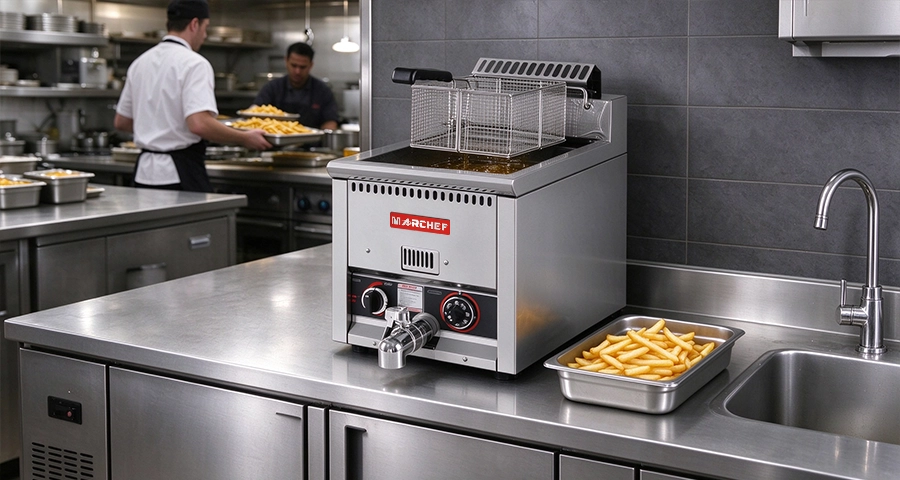
I always inspect the supply lines before signing off on any equipment delivery. Natural gas systems run on low pressure between 4 inches and 7 inches water column. Liquid propane requires high pressure between 10 inches and 14 inches water column. If you connect propane into a natural gas burner without changing the internal orifices, you will create a severe fire hazard.
Pipe sizing is equally important. When you set three or four gas fryers side by side, you cannot feed them from a small pipe. When all burners ignite together during a rush, narrow pipes cause gas starvation. The burner flames flutter, heat recovery drops, and the pilot lights extinguish.
Utility Supply Requirements
| System Type | Required Supply Pressure | Typical Pipe Size | Electrical Requirements | Critical Risk |
|---|---|---|---|---|
| Natural Gas | 4″ to 7″ W.C. | 3/4″ to 1-1/4″ NPT | 120V / 230V for Controls | Low flame from undersized manifold |
| Liquid Propane | 10″ to 14″ W.C. | 1/2″ to 3/4″ NPT | 120V / 230V for Controls | Tank freeze-up in cold weather |
| 3-Phase Electric | Not Applicable | Not Applicable | 208V, 240V, or 400V 3-Phase | Breaker tripping from phase imbalance |
Electric equipment requires a thorough review of the main electrical cabinet. Commercial kitchens need three-phase electrical circuits for high-wattage fryers. You must check that the main panel has enough breaker capacity. Adding new panels or wiring often costs more than the fryer itself. Propane tanks also need adequate outdoor space to meet zoning rules, and cold weather can freeze tank valves if you pull fuel too quickly.
How Do Ventilation and Fire Suppression Codes Affect Fuel Choice?
Did you budget for a commercial exhaust hood and a wet-chemical fire suppression system when planning your new fryer line? Ignoring local fire codes can stop building inspectors from granting your business license or cause insurers to cancel your coverage.
Commercial fryers require dedicated Type-1 exhaust hoods with wet-chemical fire suppression systems. Gas fryers demand higher airflow exhaust rates and mandatory gas shutoff safety interlocks, whereas electric fryers require slightly lower airflow rates but need targeted fire suppression nozzles over their heating elements.
Every commercial cooking facility must treat hot cooking oil as a serious fire hazard. Building codes require every deep fryer to sit under a Type-1 kitchen ventilation hood. This hood pulls hot grease vapor, oil mist, and combustion gases out of the kitchen workspace.
Gas fryers demand larger exhaust hoods that move more cubic feet of air per minute. The hood must pull out combustion byproducts like carbon monoxide alongside cooking smoke. Many regions enforce strict safety interlock laws. These rules state that if the exhaust fan stops working, an automatic safety valve must cut off the gas supply immediately. This valve stops unburnt gas from building up in the kitchen.
Fire and Ventilation Code Comparison
| Code Element | Electric Fryer System | Natural Gas / LP System | Safety Compliance Standard |
|---|---|---|---|
| Exhaust Hood Type | Type-1 Grease Hood | Type-1 Grease Hood | NFPA 96 / EN 16282 |
| Exhaust Airflow (CFM) | Moderate (~250-350 CFM/ft) | High (~350-450 CFM/ft) | Local Mechanical Codes |
| Emergency Fuel Interlock | Shunt-trip breaker interlock | Solenoid gas shutoff valve | BS 6173 / ANSI Z83.11 |
| Fire Extinguisher Type | Wet chemical system | Wet chemical system | UL 300 / ISO 15371 |
Electric fryers need fire safety interlocks as well. Fire codes require shunt-trip circuit breakers that cut power to the fryer elements whenever the fire system triggers. Fire suppression nozzles must point directly at the vat center. If you add built-in oil filtration systems, ensure the pump motors connect to separate electrical circuits that do not interfere with the main fire safety disconnects.
Which Regional Certifications Protect Your Commercial Kitchen Insurance?
Are you sure your imported cooking equipment holds the exact safety certifications required by your local municipal inspectors? Installing equipment without valid local marks voids your property insurance policies and exposes you to severe legal liability.
North American kitchens require ANSI Z83.11 for gas safety or UL 197 for electric safety alongside NSF sanitation marks. European kitchens mandate CE and UKCA marks under the Gas Appliances Regulation (GAR) and Low Voltage Directive to pass mandatory health inspections.
I have watched facility owners lose their insurance policies because their equipment lacked verified test marks. Testing bodies test gas equipment under extreme conditions to confirm the valves shut down if the pilot light fails. They test electrical gear to make sure wires do not melt under continuous high heat.
Sanitation certifications are just as vital as electrical safety marks. Health agencies inspect fryers to confirm that food-contact surfaces use food-grade stainless steel. They also check that corners have smooth radiuses so workers can clean out old food particles and grease.
Global Certification Standards
| Region | Gas Safety Standard | Electrical Safety Standard | Sanitation Standard |
|---|---|---|---|
| North America | ANSI Z83.11 / CSA 1.8 | UL 197 / CSA C22.2 | NSF / ANSI Standard 4 |
| Europe | EN 203-1 (GAR Directive) | EN 60335-2-37 (LVD) | EN 1672-2 Sanitation |
| United Kingdom | UKCA (Gas Regulation) | BS EN 60335-2-37 | BS EN 1672-2 Sanitation |
When local inspectors walk into your building, they look directly at the metal data plate attached to the fryer chassis. If that metal label lacks the correct certification mark, the inspector will shut down your kitchen immediately. You cannot run a commercial kitchen without proper regional test marks.
How Can Energy Rebates and Incentives Lower Your Equipment CapEx?
Do you want to cut thousands of dollars off your upfront equipment purchase costs through government grants and utility rebates? Many local energy providers pay direct cash incentives when you purchase certified high-efficiency cooking appliances.
Energy rebate programs reward commercial kitchens with upfront cash incentives when they buy ENERGY STAR certified fryers. These rebates reduce equipment purchase prices and cut annual utility bills through strict limits on idle energy use and advanced heat-exchanger designs.
Energy efficiency programs reward businesses that install high-performance kitchen equipment. High-efficiency fryers cost more to buy initially, but utility rebates often erase that price difference on day one. Certified fryers undergo strict test methods to prove their efficiency. They must heat cold cooking oil quickly while using less energy when sitting idle between orders.
Standard atmospheric gas fryers waste lots of gas while sitting idle. High-efficiency gas fryers use insulated fryer vats, pulse burners, and advanced heat tubes to lower idle energy loss. Electric fryers use advanced digital controls that turn elements on and off with high precision to prevent wasted electricity.
Rebate and Efficiency Comparison
| Fryer Category | Standard Efficiency Model | High-Efficiency Certified Model | Typical Utility Rebate Potential |
|---|---|---|---|
| Electric Fryer | 60% – 70% efficiency | > 80% thermal efficiency | Up to $1,000 per vat |
| Gas Fryer | 35% – 45% efficiency | > 50% thermal efficiency | Up to $1,500 per vat |
| Idle Energy Rate | 1,000 – 1,200 Watts / 14,000 BTU | < 800 Watts / < 9,000 BTU | Long-term lower utility bills |
National franchise brands now require their operators to meet strict energy targets. Installing certified cooking gear helps brands comply with corporate environmental goals while lowering monthly store overhead. Before you buy any fryer, ask your local energy supplier for their approved equipment list to claim your rebate.
What Pre-Order Checklist Ensures a Smooth Installation?
Have you measured your kitchen doorway widths, gas pipe threads, and exhaust clearance zones before signing your equipment invoice? Overlooking minor site dimensions causes expensive installation delays and forces you to hire emergency plumbers and electricians.
A complete pre-order checklist must verify incoming gas pressure, pipe diameters, electrical voltage, exhaust hood clearance, and physical door openings. Measuring your space and reviewing utility connections guarantees your installation team hooks up the fryer without unexpected construction delays.
I always give site managers a clear checklist before they finalize any equipment order. Kitchen layouts leave very little room for error. A multi-vat fryer battery with built-in oil pumps needs extra depth and rear clearance for utility pipes. You must also leave adequate room behind the fryer for quick-disconnect hoses and safety cables.
Many kitchens also forget about physical building access. A three-vat or four-vat fryer comes on a large wooden shipping pallet. If your kitchen doors are narrow, the freight crew cannot move the equipment into the building. Measuring doors, hallways, and kitchen corners ahead of time prevents painful delivery headaches.
Pre-Order Site Survey Checklist
| Audit Category | Required On-Site Check | Target Specification | Completed |
|---|---|---|---|
| Gas Supply Line | Check pipe diameter and incoming pressure | Minimum 3/4″ line; 4″-7″ NG or 10″-14″ LP | [ ] |
| Electrical Supply | Confirm panel voltage, phase, and breakers | Dedicated 3-phase circuit + 120V/230V for pump | [ ] |
| Exhaust Clearance | Measure hood overhang and grease filter angles | 6-inch overhang past fryer edges | [ ] |
| Physical Access | Measure doorways, tight corners, and aisle width | Minimum 36-inch clearance through all doors | [ ] |
| Safety Restraints | Inspect wall anchor points for restraining cables | Steel cable to protect flexible gas hoses | [ ] |
Taking these extra steps ensures your kitchen opens on schedule. It protects your cash flow and keeps your cooking line running smoothly from the moment you turn on the burners.
Conclusion
Choose electric fryers for maximum thermal efficiency and natural gas for lower ongoing operating costs. Always audit utility lines and ventilation codes to ensure seamless installation.