
Cold beef patties hit your hot griddle and instantly drop the surface heat. Your burgers start to turn gray, grease pools everywhere, and your lunch rush turns into total chaos.
Smashburger chains need a 1-inch thick commercial griddle plate because it acts like a giant heat battery. The thick steel stores enough energy to sear cold beef instantly without losing temperature. It prevents the plate from warping under heavy smash pressure and guarantees a crisp crust on every patty.
I learned this hard lesson when my first kitchen setup failed during a brutal weekend rush. You cannot afford to lose your crust, so let us break down how thermal mass really works.
How Does Thermal Mass Solve Heat Loss in Smashburger Operations?
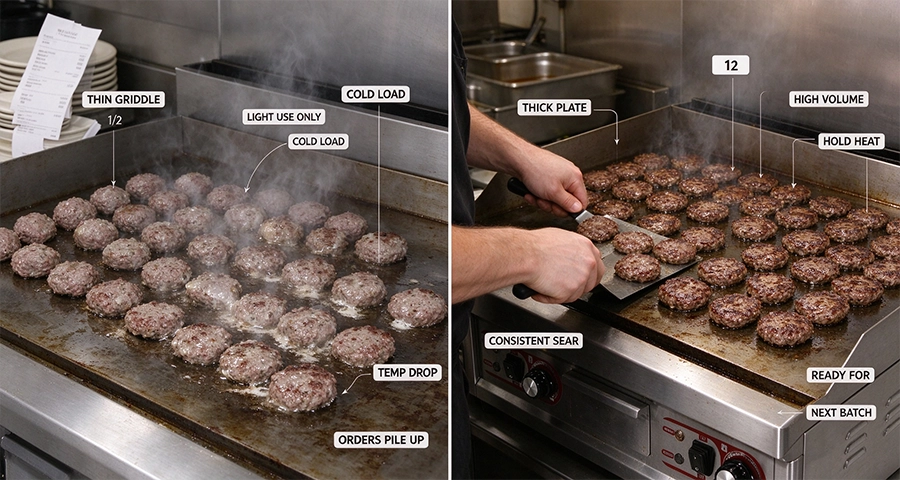
You drop twelve cold beef balls onto your griddle at once. The surface temperature suddenly plummets, your meat begins to steam in its own grease, and your crispy crust disappears completely.
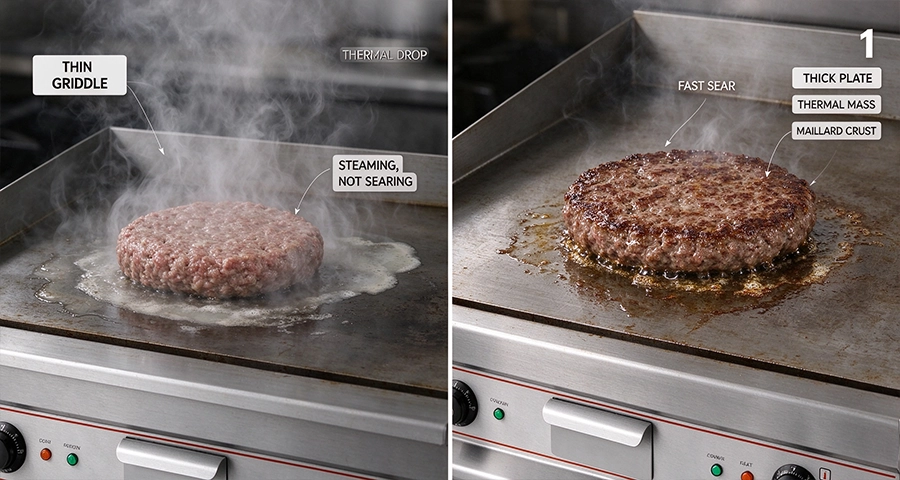
The 1-inch steel plate solves heat loss by storing massive amounts of energy inside the metal before the meat touches it. This stored heat sears the meat instantly. It bridges the delay before the gas burners turn back on, stopping meat juices from pooling on the steel.
The Boiled Burger Effect: Why Heat Drop Ruins Searing
I watch line cooks make this mistake every single week. They put cold, high-fat beef onto a thin steel plate. The cold meat pulls the heat out of the steel immediately. Water leaves the meat and cannot turn into vapor fast enough. The meat boils in liquid instead of frying in fat. You lose the dark, crispy Maillard crust that makes smashburgers taste great. You get a gray, rubbery patty that customers send back to the counter.
Thermal Mass: Bridging the Thermostat Lag
Griddle thermostats do not react in one second. A standard sensor needs thirty to sixty seconds to feel a drop in temperature and fire the burner. A thin plate loses its heat during this mechanical delay. A 1-inch plate holds enough thermal mass to carry the cooking process on its own. The stored heat finishes the sear while the burners cycle back on.
| Feature | 1/2-Inch Plate | 3/4-Inch Plate | 1-Inch Plate |
|---|---|---|---|
| Heat Drop After Loading | High (drops 35°C to 50°C) | Moderate (drops 20°C to 30°C) | Low (drops under 10°C) |
| Risk of Meat Steaming | Severe during rush hours | Occasional on full loads | Almost zero |
| Thermostat Response Gap | Metal goes cold before fire starts | Metal cools slightly | Stored heat bridges the time lag |
Plate Thickness Comparison: Is 1/2″ or 3/4″ Enough for Heavy Volume?
You want to buy a cheaper, thinner griddle plate to save money. The equipment salesperson says it works fine, but your orders pile up and your tickets start backing up.
A 1/2-inch plate only suits light breakfast duty, and a 3/4-inch plate handles standard restaurant traffic. A 1-inch plate is the only real choice for high-volume burger chains that run continuous orders all day. It maintains high heat without stopping and cooks batches at the exact same speed.
1/2-Inch: Light Duty and Off-Peak Limits
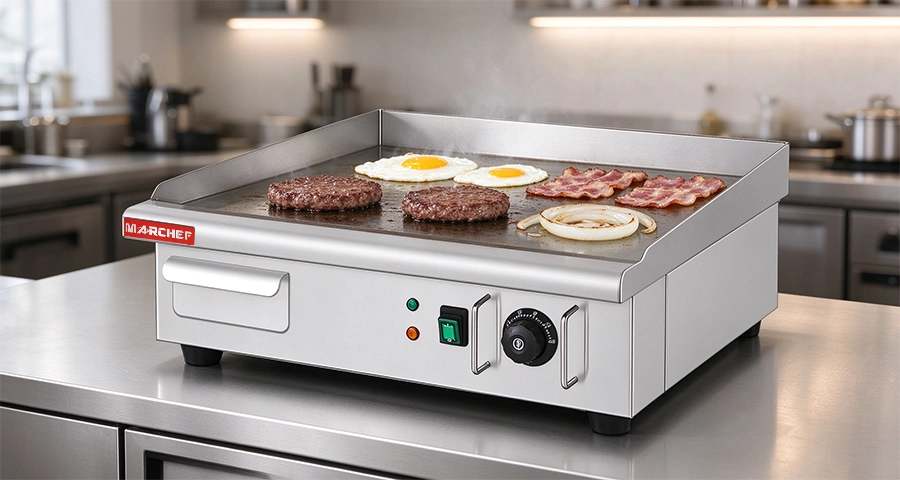
I often see small diners start with 1/2-inch plates to cut setup costs. These plates work well for eggs, pancakes, and warm sandwiches. They warm up fast in the morning. They save gas when cooking simple items one by one. But they fail when you smash rows of cold meat onto them. The surface goes cold, and you must wait several minutes between batches to regain lost heat.
3/4-Inch: The Mid-Volume Benchmark
A 3/4-inch plate serves as the regular standard for average casual restaurants. It handles moderate diner rushes with good reliability. It holds enough heat for mixed menus that cook chicken breasts, buns, and bacon together. But when you slam it with back-to-back burger orders for two hours straight, the temperature gradually slides downward.
1-Inch: The High-Throughput Franchise Standard
Fast-paced franchise chains cannot wait for griddles to reheat. A 1-inch plate stays hot no matter how fast your crew works. You can cover the entire surface with cold beef, scrape it clean, and drop another round right away. The cook time stays identical on every ticket.
| Performance Metric | 1/2-Inch Plate | 3/4-Inch Plate | 1-Inch Plate |
|---|---|---|---|
| Target Daily Volume | Under 100 burgers | 100 to 300 burgers | Over 300 burgers |
| Pre-Heat Time Required | 12 to 15 minutes | 20 to 25 minutes | 35 to 45 minutes |
| Surface Recovery Speed | Slow | Moderate | Instant continuous sear |
Structural Durability: Can Your Griddle Plate Resist Smash Pressure?
Your cooks lean their full body weight onto heavy steel presses all day long. Thin metal bends under this daily punishment, leaving you with bent plates and broken weld seams.
A 1-inch steel plate provides the mechanical strength needed to resist heavy press force without bending. It also resists thermal shock when cooks pour ice or cold water onto the hot metal during cleaning, keeping the surface dead flat for years.
Mechanical Load: Handling Heavy Press Force
Smashburgers require intense downward force to spread the meat wafer-thin against the hot steel. Line cooks lean hard on their spatulas and iron presses during every shift. A 1/2-inch plate flexes under this repeated force. Over months of use, the center of the plate develops a low dip. When the plate is not flat, grease and rendered beef tallow run into the center pool. Your burgers end up shallow-frying unevenly instead of searing on a dry, hot plane.
Thermal Shock: Preventing Steel Distortion
Kitchen crews want to clean the griddle quickly at the end of the night. They pour cold water or scrape ice over a 200°C plate to loosen burnt carbon. This sudden drop in temperature causes extreme thermal shock. Thin steel shrinks unevenly, pulling away from the side splashes and cracking the perimeter welds. A thick 1-inch block of steel absorbs this temperature shift easily and stays completely flat.
| Durability Factor | 1/2-Inch Plate | 3/4-Inch Plate | 1-Inch Plate |
|---|---|---|---|
| Resistance to Press Deflection | Poor (visible flex) | Moderate (minimal flex) | Total rigidity (zero flex) |
| Thermal Shock Resistance | High risk of plate warp | Medium risk of weld crack | Maximum resistance to distortion |
| Surface Profile Stability | Forms dips over time | Holds flat with careful use | Stays dead flat permanently |
How Does Steel Thickness Create Multi-Unit Franchise Consistency?
A customer buys a burger at your downtown store and loves the crust. Next week, they visit your suburban store, get a pale, soggy burger, and post an angry review online.
A 1-inch plate creates true consistency across multiple stores by locking in cook times. It provides stable surface temperatures across every square inch during peak rush hours, eliminating cold spots and taking human guesswork away from kitchen staff.
Standardizing Cook Times at Peak Hours
Franchise operations rely on strict timing systems. The recipe card tells the cook to press the meat, sear it for ninety seconds, flip it once, add cheese, and serve. If the griddle plate cools down during lunch hour, that ninety-second rule fails. The burger comes off the grill raw in the middle and pale on the outside. A 1-inch plate keeps surface heat rock-solid at 200°C. Ninety seconds always means ninety seconds, regardless of how many orders you take.
Balancing Pre-Heat Time and Operating Efficiency
Thick griddle plates take longer to heat up when you open the store. A 1-inch plate needs roughly forty minutes to reach target temperature, while a 1/2-inch plate heats in fifteen minutes. But once that thick plate absorbs heat, it works like a thermal flywheel. You can turn your gas burners down to lower settings during steady service. The stored thermal energy does the work, which keeps your kitchen line cooler and eases the load on your exhaust hood.
| Operational Factor | Thin Plate Operations | 1-Inch Plate Operations |
|---|---|---|
| Cook Time Stability | Varies by rush volume | Identical on every ticket |
| Kitchen Ambient Heat | Higher (burners run constantly) | Lower (burners cycle smoothly) |
| Crew Training Difficulty | High (cooks must judge heat loss) | Low (cooks follow fixed timers) |
Dealer Insights: Why Should Equipment Buyers Avoid Under-Specced Units?
You buy cheaper griddles to stay under budget on your new store opening. Soon, service calls flood in, heating elements break down, and you spend your profits on warranty repairs.
Buying an under-specced griddle costs more money in the long run because it fails under chain restaurant workloads. Specifying heavy-duty 1-inch units cuts warranty claims, stops chassis twisting, prevents burner burnouts, and protects long-term store profits.
The High Cost of Selling Under-Specced Units
I see operators buy equipment based only on the initial price tag. That cheaper unit works fine for three months. Then, continuous high-heat cycling burns out the gas valves and cracks the body welds. The store owner loses money every day the griddle sits broken. Emergency repair calls cost hundreds of dollars each visit. If a dealer recommends a light-duty plate to a smashburger brand, they trade a short-term sale for an unhappy client who never returns.
Specifying Heavy-Duty Units for Chains
A 1-inch griddle plate uses deep-drilled capillary channels for its thermostat sensors. The sensor sits just fractions of an inch below the actual cooking surface, reading real food-contact heat. Cheaper, thinner plates just clamp the thermostat probe to the bottom of the steel plate. Bottom sensors read the burner flame rather than the top surface heat. Recommending a 1-inch griddle ensures accurate temperature control and keeps the kitchen running without breakdowns.
| Lifecycle Consideration | Budget Griddle Unit | Heavy-Duty 1-Inch Griddle |
|---|---|---|
| Expected Commercial Lifespan | 2 to 3 years under heavy use | 8 to 10+ years under heavy use |
| Common Failure Points | Broken welds, warped plate, burned sensors | Normal wear on gas knobs and igniters |
| Total Cost of Ownership | High due to frequent service calls | Low due to simple maintenance |
Engineering Spec Matrix: Which Plate Thickness Matches Your Needs?
You need to pick the right griddle plate thickness for your specific kitchen setup. Looking at steel specifications without clear operational data makes choosing the right piece of equipment hard.
The choice comes down to your cooking technique, daily menu items, and peak order speed. A 1/2-inch plate matches short-order breakfast diners, a 3/4-inch plate fits mixed family restaurants, and a 1-inch plate remains mandatory for dedicated smashburger operations.
Breaking Down the Physical Engineering Differences
Selecting griddle plates requires you to match the physics of the metal to your cooking routine. Steel absorbs, holds, and transfers thermal energy at fixed physical rates. When you push beyond those mechanical limits, the kitchen breaks down. Thin plates transfer heat upward quickly from the flame, but they possess almost no storage capacity. Heavy plates take substantial energy to heat up initially, but they shield your cooking process from the shock of cold ingredients.
Matching Kitchen Menu to Griddle Core Specs
Look at what your team cooks every single hour. If you prepare delicate pancakes, scrambled eggs, and French toast, a 1-inch plate slows down your ability to change temperature quickly between different recipes. A breakfast cook often needs to drop temperatures from 190°C down to 150°C quickly. But if your main revenue comes from smashing cold, fatty beef balls into sizzling crusts, heat stability is the only thing that protects your quality.
| Technical Specification | 1/2-Inch Carbon Steel | 3/4-Inch Carbon Steel | 1-Inch Carbon Steel |
|---|---|---|---|
| Plate Weight (per sq. foot) | ~20.4 lbs (~9.2 kg) | ~30.6 lbs (~13.9 kg) | ~40.8 lbs (~18.5 kg) |
| Thermostat Style | Surface bottom-mounted | Surface bottom-mounted | Internal embedded capillary |
| Temperature Variance | ± 15°C to 25°C | ± 10°C to 15°C | ± 3°C to 5°C |
| Deflection Resistance | Weak under high impact | Good under moderate load | Maximum under heavy mechanical force |
| Ideal Application | Breakfast, eggs, wraps | Casual pubs, mixed grills | Dedicated smashburger franchises |
Conclusion
A 1-inch commercial griddle plate provides the thermal mass, structural strength, and temperature stability you need to sear smashburgers fast without warping equipment or ruining food quality.